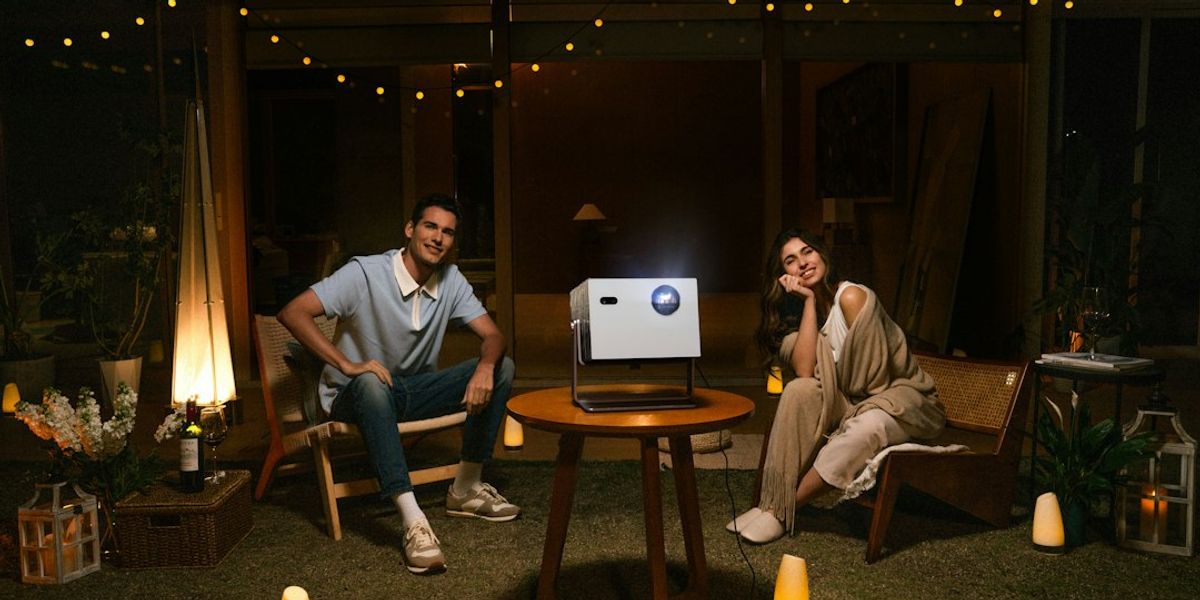
Almost every disappointing backyard movie night fails for one of four reasons, and only one of them is the projector. The other three are light, sound, and the fifty feet of cable nobody measured. Get those right and a $40 projector looks genuinely good. Get them wrong and a $900 one looks washed out.
Here is the setup that works, in the order that actually matters.
Start later than you think
The single biggest mistake is starting at sunset. The sky keeps throwing usable light onto your screen for roughly half an hour after the sun is gone, and it does not get properly dark until 70 to 90 minutes after sunset at mid-latitudes.
This is worth being concrete about, because it explains why the same gear can look great one night and terrible the next.
A 100-inch 16:9 screen is about 87 inches wide and 49 inches tall — call it 2.8 square metres. A projector rated at 300 ANSI lumens spread over that area puts roughly 110 lux on the screen at full white. For the picture to look contrasty rather than grey, the ambient light landing on that same screen needs to be a small fraction of it — under about 10 lux.
Where does that put you?
• End of civil twilight (sun 6° below the horizon): around 3 lux. Workable.
• Full moon, clear sky: 0.1 to 0.3 lux. Fine.
• Twenty minutes after sunset: still tens of lux. Not fine.
Practical rule: schedule the movie for 45 minutes after sunset, not at sunset. If you have kids who need an earlier start, you need a much brighter projector, not a bigger screen.
And kill the porch light. One unshielded bulb pointed anywhere near the screen undoes more contrast than any upgrade you can buy.
Brightness: read the ANSI number, ignore the big one
Budget projector listings advertise two very different things and hope you confuse them. "9000 lumens" is usually an LED source figure or pure marketing. ANSI lumens is a measured standard. The inflated number is commonly 3 to 10 times the real ANSI figure.
What you actually need, in a properly dark yard:
• 80 to 100 inch picture: 200 to 500 ANSI lumens is genuinely enough
• 120 inch picture: 700+ ANSI
• Any ambient light at all — streetlight, neighbour's floodlight, dusk: 1000+ ANSI
That last row is the honest dividing line. A sub-$50 projector cannot do a bright 150-inch picture at dusk, and no listing that claims otherwise is telling you the truth. What it can do, very well, is a 90-inch picture in a dark backyard — which is the setup most people actually want.
Native resolution deserves the same scepticism. "4K decoding" or "supports 4K" means the chip accepts a 4K signal and then displays it on a 720p or 1080p panel. It is not a lie, but it is not 4K either. At ten feet from a 90-inch screen, 720p is softer than you would accept on a TV and perfectly watchable for a movie in the dark.
Size the picture to the projector and the seating
Two numbers decide your screen size: how far back the projector sits, and how far back people sit.
Throw ratio is the projector's distance divided by image width. Most compact projectors land around 1.2:1, so a 100-inch screen (87 inches wide, or 7.3 feet) wants the projector about 8.7 feet back. Check the spec before you commit to a screen size — a short-throw unit and a long-throw unit need very different yards.
For viewers, comfortable distance is 1.5 to 2.5 times the screen width. A 100-inch screen means seating 11 to 18 feet from it. Further than that and you have paid for size you cannot resolve; closer and the softness shows.
The screen: three options, ranked
A proper foldable screen with grommets and stakes. Best picture, and the grommets matter more than the fabric. A screen that is not under tension will ripple in any breeze and the picture crawls with it.
A bare white wall or a light garage door. Free, perfectly flat, and better than a badly hung sheet. The limitation is that you are stuck with wherever the wall is. Avoid any surface with texture — stucco and wood fencing scatter the image and mush the detail.
A bedsheet. Workable with two caveats. Light passes straight through a single sheet, so you lose brightness and anyone behind it gets a free show; double it or back it with something dark. And it will wrinkle. Stretch it hard on all four sides.
Whatever you use, keep it out of the wind. A taut freestanding screen is a sail, and above about 15 mph you are holding a kite, not watching a film.
Sound is where most setups actually fail
Indoors, a projector's built-in 3-to-5-watt speaker is thin but audible, because walls and a ceiling reflect the sound back at you. Outdoors there is nothing to reflect off. The sound leaves the speaker and simply goes away. The same projector that was fine in the living room is unintelligible on a lawn.
Plan for external sound from the start:
• One decent portable Bluetooth speaker is a large improvement. Two, placed at the edges of the screen and pointed at the seating, is a much larger one.
• Watch the latency. Many cheap projectors have 100 to 200 milliseconds of Bluetooth audio delay, which is enough to visibly break lip sync. A 3.5mm cable to the speaker eliminates it entirely. If you only own Bluetooth speakers, test a dialogue-heavy scene before guests arrive.
• Point speakers away from neighbours where you can. Outdoor sound carries much further than you expect at night.
Power, cable, and the boring part that strands you
Add it up before you run anything: a compact projector draws 40 to 80 watts, a powered speaker 10 to 30. Call the whole setup 150 watts worst case.
• Use an outdoor-rated extension cord. For runs over 50 feet, 14 AWG or thicker, or you will see voltage drop.
• Tape or stake the cable down across any walkway. It is dark and people will be carrying bowls.
• A portable power station is the clean alternative: a 300Wh unit runs a 60-watt projector for roughly four hours, which covers two films.
The things that ruin it anyway
• Mosquitoes. A still, warm evening with a bright light source is the ideal trap. Have a plan before people are sitting down.
• Dew. Late in the evening moisture settles on the lens and the screen. If you are running past midnight, expect a slow softening and wipe the lens.
• Seating and dew together. Ground gets wet earlier than you think — waterproof-backed blankets, not bare quilts.
• Insects in the beam. Anything flying through the light path shows up as a shadow the size of a dinner plate. Nothing to do about it; just know it is normal.
A parts list at three budgets
Starter, dark yard, 90-inch picture. A compact projector in the 200 to 350 ANSI range, a doubled bedsheet or bare wall, one Bluetooth speaker on a cable, and an outdoor extension cord. This genuinely works, and it is where we would start.
Our own two units sit in this tier and we will describe them honestly. The HikePod S1 runs Android 12 with WiFi 6 and accepts a 4K signal; the HikePod X1 is rated 300 ANSI lumens with wireless mirroring. Both are built for a dark backyard at 80 to 100 inches. Neither will fight dusk at 150 inches, and we would rather say so than sell you the 9000-lumen fantasy.
Mid, occasional ambient light, 100 to 120 inch picture. A 700 to 1000 ANSI projector, a real foldable screen with stakes, two speakers, and a 300Wh power station so placement is not dictated by the nearest outlet.
Proper, repeatable, any-conditions. A 2000+ ANSI projector, a fixed or tensioned screen on a frame, a wired 2.1 setup, and a permanent outdoor outlet. At this point you are building an outdoor cinema rather than running a movie night, and the cost is dominated by the screen and the wiring, not the projector.
Pre-flight checklist
Run this an hour before guests arrive, with the gear in its final position.
• Projector focused and keystone-corrected on the actual screen, not a test wall
• Picture fits the screen with a small margin on all four sides
• Audio tested on a dialogue scene, lip sync confirmed
• Porch and path lights off or shielded; check what the neighbours have on
• Cable run taped down, nothing crossing a walkway untaped
• Screen under tension, guy lines or stakes in
• Film already downloaded, not relying on the WiFi reaching the end of the garden
• Mosquito plan actually deployed, not sitting in the garage
Get those eight right and the gear matters much less than you would think. A modest projector in genuine darkness, on a flat tensioned surface, with sound you can hear, beats an expensive one fighting a porch light every time.