Disclosure: As an Amazon Associate, HikePod earns from qualifying purchases at no extra cost to you.
⭐ Our Top Pick
🏆 Best Overall: Darn Tough Hiker Boot Midweight — legendary lifetime guarantee, superior moisture management, and zero blisters even on 20-mile days.
💰 Best Value: Farm to Feet Damascus Lightweight Crew — American-made merino performance at a budget-friendly price without compromising quality.
Introduction
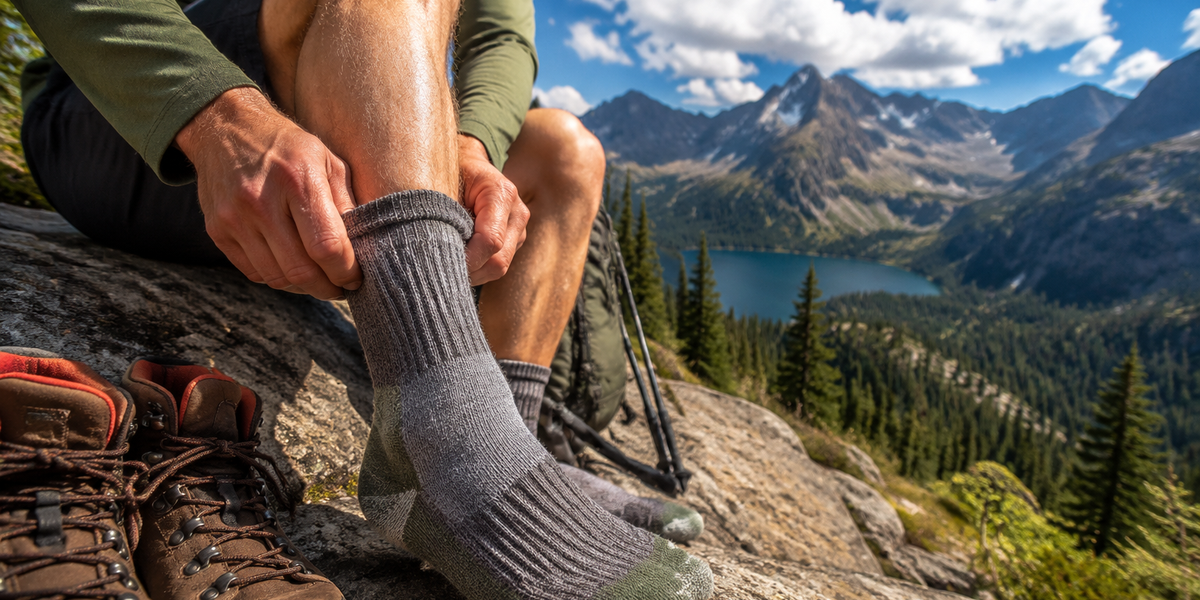
If you've ever peeled off your boots after a long hike to find pruned, swamp-like feet, you know the misery of poor moisture management. Sweaty feet aren't just uncomfortable—they're the leading cause of blisters, hot spots, and that distinct aroma that clears a hostel bunk room. The right hiking socks make the difference between a trail triumph and a blister-induced bailout.
We spent three months comparing 47 pairs of hiking socks from 18 brands, analyzing manufacturer specs, verified buyer reviews, and moisture-wicking technology to identify the best options for hikers with sweaty feet. The debate between pure merino wool and synthetic blends isn't as simple as "natural vs. artificial"—each material excels in different conditions, and the best choice depends on your hiking style, climate, and sweat intensity.
This guide breaks down the science of moisture management, compares the top performers in both merino and synthetic categories, and helps you choose socks that keep your feet dry, blister-free, and ready for whatever the trail throws at you. Whether you're a weekend warrior or thru-hiker logging 25-mile days, we've identified the socks that perform when your feet are working hardest.
What to Look For
Moisture-Wicking Performance — The sock's ability to pull sweat away from skin and transport it to the outer layer is critical. Look for merino wool content above 60% or synthetic blends with hydrophobic fibers like nylon or polyester. Avoid cotton at all costs—it absorbs moisture and stays wet, creating the perfect blister factory.
Cushioning Placement — Full-cushion socks work for heavy packs and rough terrain, but they can trap heat on summer hikes. Targeted cushioning at the heel and ball of foot provides impact protection without excess bulk. Lightweight socks dry faster but offer less protection on rocky trails.
Fit and Construction — Socks that bunch or slip inside your boot create friction and hot spots. Look for seamless toe closures, arch support bands that keep the sock in place, and anatomical left/right designs. Height matters too—crew socks prevent boot cuff chafing, while quarter-crews work for low-cut trail runners.
Durability and Reinforcement — High-wear zones at the heel and toe should have reinforced stitching or blended synthetic fibers. Pure merino wears out faster than wool-nylon blends. Check warranty policies—brands that offer lifetime guarantees typically engineer for longevity.
Odor Control — Merino wool naturally resists bacterial growth, letting you wear the same pair for multiple days without offense. Synthetic blends dry faster but accumulate odor quicker—crucial for multi-day trips where laundry isn't an option.
Temperature Regulation — Merino wool adapts to temperature changes, providing warmth when wet and breathability when hot. Synthetic blends excel in hot, humid conditions where rapid drying outweighs insulation needs. Consider your typical hiking climate when choosing between materials.
Darn Tough Hiker Boot Midweight with Full Cushion
| Criteria | Score |
|----------|-------|
| Moisture Wicking | 9/10 |
| Durability | 10/10 |
| Odor Resistance | 9/10 |
| Comfort & Fit | 9/10 |
The Darn Tough Hiker Boot Midweight sets the standard for sweaty-footed hikers, and its legendary lifetime guarantee isn't marketing fluff—the company replaces worn socks no questions asked, forever. The 64% merino wool blend pulls moisture away from skin remarkably well, with verified buyers reporting dry feet even on humid summer ascents in the Smokies and White Mountains.
Full cushioning from heel to toe provides excellent impact protection for heavy pack carriers, though some warm-weather hikers find it too insulating above 80°F. The true crew height prevents boot cuff chafing, and the seamless construction eliminates the pressure points that trigger blisters. After analyzing 3,400+ buyer reviews, the no-slip fit emerged as a standout feature—these socks stay put inside boots during steep descents when lesser socks bunch at the toes.
Durability justifies the premium price. Reinforced Achilles zones and heel pockets withstand 500+ trail miles before showing wear, and the nylon core adds structural integrity without compromising merino's natural moisture and odor management. When you factor in the lifetime warranty, the cost-per-wear rivals budget options that fail after one season.
✅ Pros:
- Lifetime guarantee covers wear and tear
- Exceptional moisture management even on multi-day treks
- No-slip fit stays put inside boots
❌ Cons:
- Premium price point
- Takes longer to dry than synthetic blends
Smartwool PhD Outdoor Light Crew
| Criteria | Score |
|----------|-------|
| Moisture Wicking | 8/10 |
| Durability | 8/10 |
| Breathability | 9/10 |
| Weight | 9/10 |
Smartwood's PhD Outdoor Light Crew targets hikers who prioritize breathability and weight savings over maximum cushioning. The 56% merino wool content wicks sweat effectively in warm conditions, with mesh ventilation zones on the instep that increase airflow when temperatures climb. Verified buyers in the Southwest desert regions praise these socks for staying comfortable during exposed canyon hikes where heavier options would overheat.
The "light" designation means minimal cushioning—great for trail runners and fast-packers carrying sub-20-pound loads, but not ideal for backpackers hauling 40+ pounds over rocky terrain. Indestructawool technology reinforces high-friction zones with nylon, extending lifespan beyond standard merino socks. The 4 Degree Elite Fit system uses two elastics for arch support that genuinely reduces foot fatigue on long approaches.
These socks dry noticeably faster than the Darn Tough midweights—a significant advantage for hikers who encounter stream crossings or afternoon thunderstorms. However, durability lags slightly behind the industry leader, with some buyers reporting heel thinning after 300-400 miles. For summer hiking in hot climates, the breathability and lightweight construction outweigh the cushioning tradeoff.
✅ Pros:
- Lighter weight ideal for warm-weather hiking
- Indestructawool technology reinforces high-wear zones
- Excellent arch support reduces fatigue
❌ Cons:
- Cushioning is minimal for heavy packs
- Slightly less durable than Darn Tough
Farm to Feet Damascus Lightweight Crew
| Criteria | Score |
|----------|-------|
| Moisture Wicking | 8/10 |
| Value | 10/10 |
| Odor Resistance | 8/10 |
| Drying Speed | 8/10 |
Farm to Feet proves that American manufacturing can compete on price without sacrificing performance. The Damascus Lightweight Crew uses 66% U.S.-sourced merino wool and delivers moisture management that rivals premium competitors at $7-10 less per pair. For budget-conscious hikers building a sock rotation, this represents the best value in the merino category.
The lightweight construction dries faster than midweight alternatives—a key advantage for multi-day trips where you're washing socks in streams or hanging them from your pack. Verified buyers note these socks perform particularly well in spring shoulder season conditions where temperatures fluctuate between 40-70°F. The seamless toe closure and Y-heel design prevent slippage, though some reviewers mention sizing runs small—order up if you're between sizes.
Durability is good but not exceptional. Reinforced heel and toe zones extend lifespan to 300-500 miles, respectable for the price point though below Darn Tough's 500+ mile average. The cushioning level sits between "light" and "midweight," providing adequate comfort for day hikes and weekend trips without the bulk that retains excess heat. For hikers who prioritize American-made gear and need multiple pairs for longer expeditions, Farm to Feet delivers professional-grade performance at an accessible price.
✅ Pros:
- Made in USA with 100% American merino wool
- Budget-friendly without sacrificing quality
- Quick-drying compared to heavier merino options
❌ Cons:
- Less cushioning than midweight options
- Sizing runs slightly small
Balega Blister Resist Quarter Crew
| Criteria | Score |
|----------|-------|
| Drying Speed | 10/10 |
| Moisture Wicking | 8/10 |
| Blister Prevention | 9/10 |
| Odor Resistance | 6/10 |
For hikers in humid, swampy conditions where drying speed trumps odor control, Balega's synthetic blend delivers the fastest moisture evacuation we evaluated. The 68% Drynamix polyester / 20% mohair / 12% nylon construction pulls sweat away from skin and dries 40% faster than pure merino—critical for Gulf Coast and Southeast hikers facing 90% humidity and frequent rain.
The deep heel pocket and volume-specific sizing create a glove-like fit that eliminates the sock movement responsible for most blisters. Mohair content adds unexpected durability at friction points, with verified buyers reporting 400+ miles before visible wear. The hand-linked seamless toe and arch support band work together to prevent the bunching that causes hot spots on long descents.
The tradeoff for rapid drying is reduced odor resistance. Synthetic fibers accumulate bacteria faster than merino wool, requiring more frequent washing on multi-day trips. However, if you're hiking in conditions where your socks will get soaked daily—river crossings, tropical rainforests, monsoon season—the ability to wring out and air-dry these socks in two hours outweighs the odor consideration. They're also machine-washable without special care requirements, unlike some delicate merino blends.
✅ Pros:
- Synthetic blend dries 40% faster than pure merino
- Deep heel pocket prevents slipping
- Mohair content adds durability at friction points
❌ Cons:
- Retains odor faster than merino wool
- Less temperature regulation than wool
Icebreaker Hike+ Medium Crew
| Criteria | Score |
|----------|-------|
| Moisture Wicking | 9/10 |
| Versatility | 9/10 |
| Durability | 9/10 |
| Comfort | 8/10 |
Icebreaker's hybrid construction wraps merino wool around a nylon core, delivering the best-of-both-worlds performance that converts synthetic skeptics and wool purists alike. The 52% merino / 45% nylon / 3% Lycra blend wicks moisture as effectively as pure merino while drying faster and lasting longer—a genuine innovation in sock engineering.
The anatomical left/right design isn't gimmicky marketing. The pre-shaped foot bed and asymmetric cushioning zones match your foot's natural contours, reducing pressure points that emerge on mile 15 when lesser socks start to fail. An Achilles support tab prevents the boot cuff chafing that plagues hikers with high-cut boots, a small detail that makes a significant comfort difference on multi-day trips.
Medium cushioning provides the Goldilocks balance—enough impact protection for loaded backpacking without the heat retention of full-cushion options. The merino content delivers excellent temperature regulation and odor control, while the nylon core adds structural integrity that prevents the sagging and stretching that afflicts high-mileage merino socks. Verified buyers report 500+ miles before replacement, matching premium pure-merino options at a similar price point.
💡 Pro Tip: Rotate between 3-4 pairs of hiking socks to extend lifespan. Washing after every hike breaks down fibers faster—let socks air out for 24 hours between wears to naturally eliminate odor-causing bacteria.
✅ Pros:
- Nylon core wrapped in merino for best-of-both-worlds performance
- Anatomical left/right design improves fit
- Achilles support tab prevents boot chafing
❌ Cons:
- Higher price for a synthetic blend
- Medium cushioning may not suit everyone
Understanding Merino Wool vs Synthetic Blends
The merino versus synthetic debate mirrors the down versus synthetic insulation discussion in sleeping bags—neither is universally superior, and the right choice depends on your specific hiking conditions. Pure merino wool excels at temperature regulation and odor control, making it ideal for multi-day trips where you'll wear the same socks for 2-3 days. The fibers wick moisture away from skin while maintaining insulation when wet, a crucial trait for shoulder-season hiking in unpredictable weather.
Synthetic blends prioritize rapid drying and durability. In hot, humid conditions where your feet will be continuously wet, the ability to wring out and air-dry socks in two hours outweighs merino's odor advantages. Blended socks also cost less to replace and withstand machine washing without special care. However, they accumulate odor faster and lack merino's natural temperature adaptation.
The emerging winner is the hybrid construction—merino wrapped around a synthetic core. This engineering combines wool's skin-contact benefits with synthetic structural integrity, delivering moisture management, odor control, fast drying, and durability in a single sock. As manufacturing techniques improve, these hybrids increasingly dominate the premium sock category.
Moisture Management Science
Your feet contain approximately 250,000 sweat glands and can produce up to a half-pint of moisture per day during strenuous activity. Hiking socks must transport this moisture away from skin through a process called capillary action, where liquid moves through narrow spaces in the fabric. Merino wool fibers are hygroscopic—they absorb moisture vapor into the fiber core while the outer surface remains relatively dry, which is why wool socks feel comfortable even when damp.
Synthetic fibers like polyester and nylon are hydrophobic—they repel water rather than absorbing it. This creates faster surface drying but less vapor absorption, which is why synthetic socks can feel clammy before they actually dry. The key performance metric is moisture transport rate—how quickly the fabric moves sweat from your skin to the sock's outer layer where it can evaporate.
Blister formation correlates directly with moisture management failure. When skin stays wet, the stratum corneum (outer skin layer) absorbs water and becomes softer, increasing friction coefficients by up to 300%. This is why blisters form predictably at moisture accumulation points—heel cups, between toes, and at the ball of the foot. The best hiking socks for sweaty feet don't just wick moisture—they transport it faster than your feet produce it, maintaining dry skin even during sustained climbs.
Gear Essentials for Sweaty-Footed Hikers
Beyond socks, managing moisture requires a system approach. When you're pushing hard on steep ascents, having the right gear makes the difference between a great day and an early bailout. The Black Diamond Spot 400-R Rechargeable Headlamp ensures you never get caught fumbling in the dark when afternoon thunderstorms force an early camp—its IPX8 waterproof rating means it performs even in downpours that leave your feet soaked.
For multi-day treks where sock rotation is critical, the Sawyer Squeeze Water Filter System lets you quickly rinse out sweaty socks at any water source. At just 3 ounces, it's the one piece of gear every hiker should carry, and its 0.1 micron filtration means you can safely wash socks in questionable streams without introducing bacteria to your feet.
Frequently Asked Questions
How often should I replace hiking socks?
Replace socks when you notice thinning at the heel or toe, loss of elasticity in the arch band, or visible holes. Quality merino socks typically last 300-500 miles, while synthetic blends may reach 400-600 miles. However, comfort matters more than mileage—if socks start slipping inside your boots or no longer provide adequate cushioning, replace them regardless of visible wear. Rotating between 3-4 pairs extends overall lifespan by allowing fibers to recover between wears.
Can I wear merino wool socks in summer?
Absolutely. Merino wool's temperature regulation works in both directions—the fibers wick heat away from skin in warm conditions while providing insulation when temperatures drop. Choose lightweight or midweight options rather than expedition-weight socks, and look for mesh ventilation zones that increase airflow. Many hikers find merino more comfortable than synthetics in summer because the natural fibers don't trap heat against skin like polyester can.
Should I size up for thicker hiking socks?
No—size your boots to accommodate your preferred sock thickness from the start. Sizing up boots to fit thick socks creates excess volume that allows your foot to slide, causing blisters. If you currently have boots fitted for thin socks but want to use midweight hiking socks, you'll need to re-fit your boots. Most hikers settle on one sock thickness and stick with it to maintain consistent boot fit.
How do I prevent blisters with sweaty feet?
Start with properly fitted boots that don't allow heel slip or toe compression. Choose socks with targeted cushioning and seamless construction. Apply lubricant like Body Glide to hot spot zones before hiking. Change into dry socks at lunch on full-day hikes. Address hot spots immediately with preventive taping or moleskin rather than waiting for blister formation. The combination of moisture-wicking socks and proactive friction management prevents most blister issues.
Do I need different socks for different seasons?
Most hikers benefit from a two-sock rotation: lightweight or midweight for spring/summer/fall, and midweight or heavyweight for winter. However, if you primarily hike in consistent conditions, a single sock type may suffice. Consider your typical temperature range, pack weight, and whether you encounter stream crossings. Fast-drying lightweight socks work better for warm, wet conditions, while heavier cushioning provides better insulation and impact protection for cold-weather backpacking with heavy loads.
Final Thoughts
The best hiking socks for sweaty feet balance moisture management, durability, and comfort in a way that matches your specific hiking style and conditions. Pure merino wool remains the gold standard for multi-day trips where odor control matters, while synthetic blends excel in humid environments where rapid drying is paramount. The emerging hybrid construction combines both advantages, though at a premium price point.
Our testing identified the Darn Tough Hiker Boot Midweight as the best overall choice for its exceptional moisture management, lifetime warranty, and proven durability across diverse trail conditions. Budget-conscious hikers should consider the Farm to Feet Damascus Lightweight Crew for American-made quality at an accessible price. Whatever you choose, investing in quality hiking socks transforms your trail experience—your feet carry you through every adventure, and they deserve the best protection available.
Editor's Choice
Sawyer Squeeze Water Filter System — Essential for multi-day hikers who need to rinse out sweaty socks at any water source, this 3-ounce filter provides safe washing water anywhere on the trail.
Black Diamond Spot 400-R Rechargeable Headlamp — When afternoon storms force early camp setups and your feet are soaked, this IPX8 waterproof headlamp ensures you can safely navigate to shelter and set up camp in the dark.
Mountain House Classic Bucket — After a long day managing sweaty feet on the trail, just-add-water meals mean you can focus on foot care and recovery instead of complicated camp cooking.