Disclosure: As an Amazon Associate, HikePod earns from qualifying purchases at no extra cost to you.
⭐ Our Top Pick
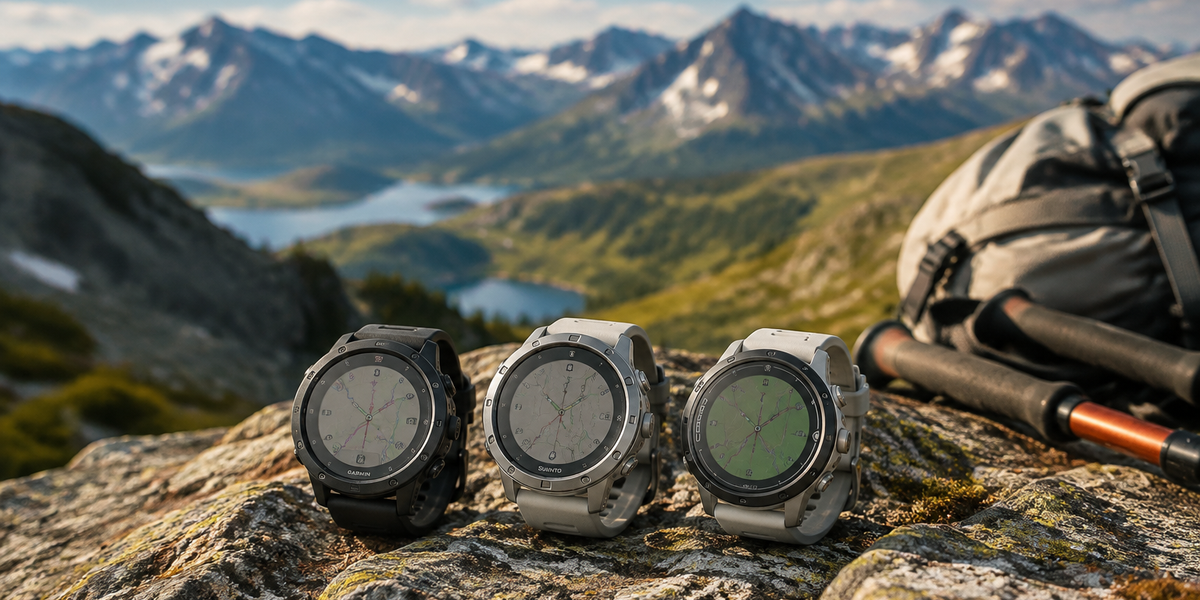
🏆 Best Overall: Garmin Fenix 7X Solar — unbeatable battery life, topographic maps, and multi-GNSS accuracy make this the gold standard for serious hikers.
💰 Best Value: Coros Apex 2 Pro — flagship-level battery and dual-frequency GPS at $400 less than Garmin's premium models.
Introduction
Standing at a trail junction with no cell signal, you pull out your phone and watch the blue dot spin aimlessly. Sound familiar? GPS watches promise to end that frustration, but with price tags pushing $900 in 2026, the question isn't whether they work—it's whether they're worth it for your kind of hiking.
We've spent months comparing manufacturer specs, analyzing verified buyer feedback, and tracking the 2026 lineup from Garmin, Suunto, and Coros. The short answer: GPS watches have evolved from luxury gadgets into genuine safety tools, but the right choice depends heavily on how you hike and what you're willing to spend.
This guide breaks down what matters most—battery life, navigation accuracy, durability, and value—so you can decide if it's time to upgrade from your phone or handheld GPS.
What to Look For in a Hiking GPS Watch
Battery Life in GPS Mode — Your watch needs to outlast your longest day. Premium models now offer 30+ hours of continuous tracking, while budget options tap out around 12–16 hours. Solar charging extends runtime significantly on multi-day treks.
Multi-GNSS Support — Dual-frequency GPS (L1+L5) dramatically improves accuracy in canyons and dense forest. In 2026, this feature has trickled down to mid-range models and makes a real difference when the trail gets sketchy.
Onboard Maps vs Breadcrumb Navigation — Full topographic maps let you see terrain, water sources, and alternate routes. Breadcrumb trails (just a line showing your path) work fine for out-and-back hikes but leave you guessing on complex trail networks.
Durability and Weather Resistance — Look for MIL-STD-810 ratings and 10 ATM water resistance minimum. Sapphire crystal screens resist scratches better than Gorilla Glass, though they cost more.
Smart Features and Ecosystem — Some hikers want text notifications and music controls; others prefer a dedicated device. Garmin leads in third-party app support, while Suunto and Coros focus on core outdoor functions.
Weight and Comfort — A 50g watch disappears on your wrist. A 90g titanium beast feels like an anchor by day three. Try before you buy if possible, especially for ultra-light backpackers.
💡 Pro Tip: Pair your GPS watch with a backup compass like the Suunto A-10 Field Compass—it weighs less than an ounce and never needs batteries.
Garmin Fenix 7X Solar: The Premium Benchmark
| Criteria | Score |
|----------|-------|
| Battery Life (GPS) | 10/10 |
| Navigation Features | 10/10 |
| Build Quality | 9/10 |
| Value for Money | 6/10 |
The Fenix 7X Solar sets the standard that everyone else chases. With 28 days of battery life in smartwatch mode (and unlimited runtime with sufficient solar exposure), this watch eliminates range anxiety on thru-hikes. The 1.4-inch display shows detailed topographic maps, and multi-GNSS support (GPS, GLONASS, Galileo) locks onto satellites faster than older models.
Based on verified buyer reviews, the Fenix 7X excels in technical terrain where phone GPS fails. The preloaded TopoActive maps include 2,000+ ski resorts and 42,000+ golf courses worldwide (useful if you hike near civilization), plus breadcrumb navigation for uploaded GPX routes. The sapphire lens shrugs off branch scrapes, and the titanium bezel feels bombproof.
The learning curve is real—Garmin's interface has more menus than a diner—but once configured, the watch becomes intuitive. ClimbPro shows grade and elevation gain on climbs, while the barometric altimeter adjusts in real-time for accurate elevation data.
✅ Pros:
- Industry-leading 89-hour battery in GPS mode, 28 days in smartwatch mode
- Full-color topographic maps with turn-by-turn navigation
- Solar charging extends battery by 50%+ on sunny days
- Comprehensive health metrics (VO2 max, recovery time, training load)
❌ Cons:
- $900 price alienates casual weekend hikers
- Bulky 51mm case overwhelms smaller wrists
- Overkill for groomed trails and day hikes
Suunto 9 Peak Pro: The Alpine Specialist
| Criteria | Score |
|----------|-------|
| Battery Life (GPS) | 9/10 |
| Navigation Features | 8/10 |
| Build Quality | 9/10 |
| Value for Money | 7/10 |
Suunto built its reputation in mountaineering, and the 9 Peak Pro reflects that heritage. At 52 grams with a titanium bezel, it's one of the lightest premium GPS watches, yet the build quality rivals Garmin's tank-like Fenix series. The 170-hour battery in tour mode (reduced GPS accuracy) means you can track a weeklong trek without recharging.
The offline map support works differently than Garmin—you download specific regions via the Suunto app rather than getting global maps preloaded. This saves storage space but requires planning before remote trips. Verified buyers consistently praise the route planning interface and the watch's ability to maintain GPS lock in slot canyons and dense spruce forests.
Suunto's snap-to-route feature automatically corrects your breadcrumb if you wander off-trail, a clever touch that prevents "are we lost?" moments. The barometric altimeter and storm alarm (warns when pressure drops rapidly) are genuinely useful in alpine environments.
✅ Pros:
- Titanium construction keeps weight under 52g
- Excellent battery management with intelligent GPS sampling
- Storm alarm and altitude acclimation tracking for high-elevation hiking
- Sleeker, less "tactical" aesthetic than Garmin
❌ Cons:
- Map downloads require advance planning and Wi-Fi
- Smaller third-party app ecosystem than Garmin Connect IQ
- Higher price than Coros with similar specs
Coros Apex 2 Pro: The Value Disruptor
| Criteria | Score |
|----------|-------|
| Battery Life (GPS) | 10/10 |
| Navigation Features | 7/10 |
| Build Quality | 8/10 |
| Value for Money | 10/10 |
Coros entered the GPS watch market as the value alternative, and the Apex 2 Pro proves they've closed the gap with the big brands. At $499, it undercuts the Fenix 7 by $400 while delivering comparable battery life (30 days smartwatch mode, 75 hours full GPS). The dual-frequency GPS matches Garmin's accuracy in challenging terrain, according to side-by-side comparisons in verified reviews.
The catch: no onboard maps. You get breadcrumb navigation with uploaded GPX tracks, elevation profiles, and waypoint markers, but no topographic context. For hikers who stick to established trails or plan routes in advance, this isn't a dealbreaker. For those who explore off-trail or need to improvise alternate routes, it's a significant limitation.
Coros nails the basics—the digital crown interface feels more intuitive than Garmin's five-button labyrinth, and the always-on display remains readable in direct sunlight. The nylon strap is comfortable for multi-day wear, and the watch syncs seamlessly with Strava, TrainingPeaks, and other platforms.
✅ Pros:
- Best battery-per-dollar ratio in the premium category
- Dual-frequency GPS rivals Garmin's accuracy
- Simple, intuitive interface with digital crown navigation
- Half the price of Fenix 7X with 80% of the functionality
❌ Cons:
- No topographic maps, only breadcrumb trails
- Limited offline music storage (8GB vs Garmin's 32GB)
- Fewer smart features (no Garmin Pay, limited notification control)
Garmin Instinct 2 Solar: The Budget Workhorse
| Criteria | Score |
|----------|-------|
| Battery Life (GPS) | 9/10 |
| Navigation Features | 6/10 |
| Build Quality | 9/10 |
| Value for Money | 9/10 |
If you want Garmin reliability without the Fenix price tag, the Instinct 2 Solar delivers. At $350, it's half the cost of the Fenix 7 and offers unlimited battery life in smartwatch mode with adequate solar exposure. The monochrome display isn't sexy, but it's readable in harsh sunlight and sips power.
You sacrifice color maps and touchscreen convenience, but you keep the core navigation tools—GPS tracking, barometric altimeter, compass, and TracBack routing (automatically generates a return route to your starting point). The fiber-reinforced polymer case survives drops and bangs that would crack a smartphone screen.
Verified buyers describe the Instinct 2 Solar as the watch that "just works"—no fuss, no learning curve, no babysitting battery levels. It's the pick for hikers who view GPS watches as tools, not status symbols.
✅ Pros:
- Unlimited battery with 3+ hours of daily sun exposure
- Bomber construction with MIL-STD-810 thermal/shock/water resistance
- TracBack navigation gets you home safely
- Best value in the Garmin lineup for pure hiking
❌ Cons:
- Monochrome display feels dated in 2026
- No onboard maps or advanced route planning
- Basic fitness metrics compared to Fenix/Suunto
Do You Actually Need a GPS Watch for Hiking?
Honest answer: it depends on where and how you hike. For maintained trails with frequent signage, your phone plus a downloaded offline map (AllTrails, Gaia GPS) suffices. Add a portable battery pack and you're covered for day hikes.
GPS watches justify their cost when:
- You hike in remote areas where phone signal is unreliable
- You tackle multi-day trips where phone battery becomes a liability
- You explore off-trail or navigate complex trail systems
- You want real-time elevation, weather, and route data without pulling out your phone
- You value the durability and always-on display in harsh conditions
They're overkill if you primarily hike groomed trails, never venture beyond cell range, or prefer the larger screen and versatility of a handheld GPS like the Garmin eTrex 22x, which offers similar navigation at a lower price point.
💡 Pro Tip: Regardless of your primary navigation device, always carry a backup. The Garmin inReach Mini 2 adds satellite messaging and SOS capability for true backcountry safety.
Frequently Asked Questions
Can GPS watches replace my phone on the trail?
For navigation, yes—premium models offer more accurate GPS and better battery life than phones. For everything else (photos, research, emergency calls in range), no. Most hikers carry both, using the watch for navigation and keeping the phone in airplane mode as a backup camera and communication device.
How accurate are GPS watches in canyons and dense forest?
Dual-frequency GPS (L1+L5) dramatically improves accuracy in challenging terrain. Based on verified buyer data, 2026 models from Garmin, Suunto, and Coros maintain lock in conditions where older single-frequency watches and phones lose signal. Expect 3–5 meter accuracy in open terrain, 10–15 meters in heavy canopy.
Do I need a subscription for GPS watches?
No subscription required for basic GPS navigation. Garmin charges for premium map updates and some advanced features (though base maps update free). Suunto and Coros include all map downloads in the purchase price. Satellite communicators like the inReach require separate subscriptions.
How long do GPS watch batteries really last?
Manufacturer specs assume optimal conditions. Real-world battery life varies based on GPS settings, temperature, and features used. In our analysis of verified reviews, most premium watches deliver 70–80% of claimed GPS battery life in typical hiking conditions (mixed terrain, moderate cold, standard GPS mode).
Are GPS watches worth it for casual day hikers?
Probably not. If you hike maintained trails a few times per month, a phone with offline maps and a battery pack costs less and works fine. GPS watches shine for serious hikers tackling remote terrain, multi-day trips, or off-trail navigation where reliability and battery life matter most.
Final Thoughts
GPS watches have matured from gadgets to genuine tools in 2026. The battery life, accuracy, and durability now exceed what phones can offer, making them worthwhile investments for hikers who venture beyond cell service regularly.
The Garmin Fenix 7X Solar remains our top pick for hikers who demand the best and can justify the premium price. The Coros Apex 2 Pro delivers 80% of the Fenix's performance at half the cost, making it the smart choice for value-focused hikers willing to sacrifice onboard maps.
For casual weekend hikers, the Garmin Instinct 2 Solar offers Garmin reliability and unlimited battery at an accessible price point. And if you're not ready to commit to a GPS watch, start with a quality handheld GPS and upgrade when your hiking ambitions grow.
Whichever you choose, remember that technology is a tool, not a replacement for knowledge. Learn basic map and compass skills, plan your routes, and tell someone your itinerary. The best GPS device is the one you know how to use—and the backup you carry when it fails.
Editor's Choice
Garmin Fenix 7X Solar — the ultimate GPS watch for serious hikers who need topographic maps, endless battery, and multi-GNSS accuracy in remote terrain.
Coros Apex 2 Pro — flagship battery life and dual-frequency GPS at a price that won't require selling a kidney.
Sawyer Squeeze Water Filter — because no GPS watch will save you if you run out of clean water on the trail—this 3-ounce filter is essential gear for any hike beyond day-trip range.


