Disclosure: As an Amazon Associate, HikePod earns from qualifying purchases at no extra cost to you.
⭐ Our Top Pick
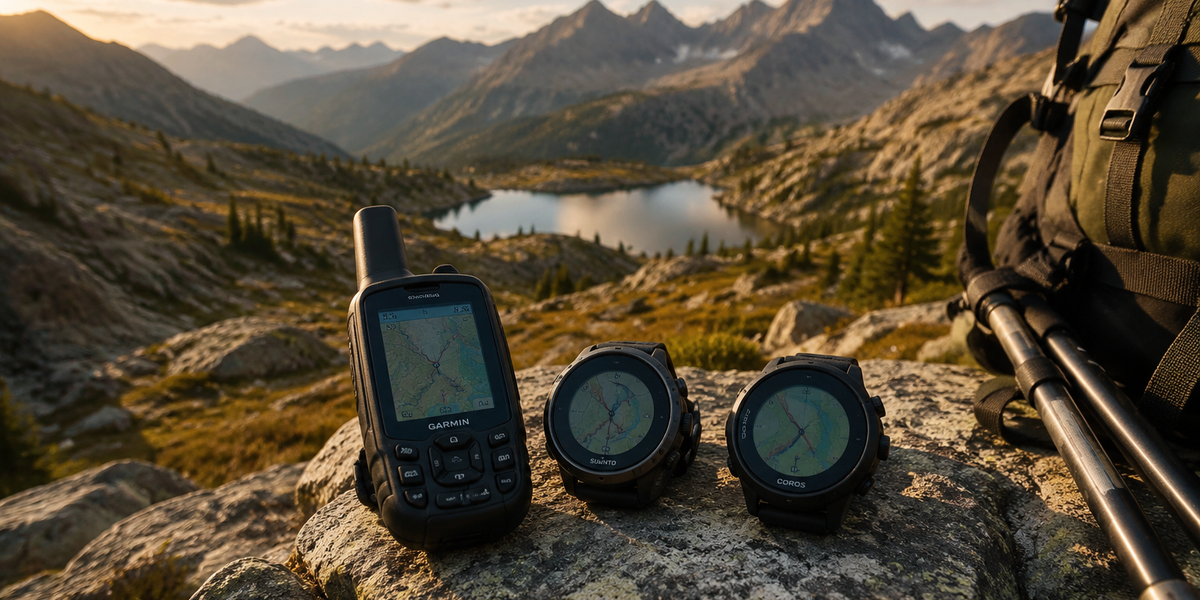
🏆 Best Overall: Garmin eTrex 22x — 25 hours on replaceable AA batteries makes this the most practical choice for multi-day hikes.
💰 Best Value: COROS APEX 2 Pro — delivers 75 hours of GPS tracking at half the price of comparable Garmin watches.
Introduction
You're five miles into a 30-mile loop when your GPS screen goes dark. Your route, your waypoints, your carefully planned water resupply points—all gone. We've heard this story too many times from hikers who trusted manufacturer battery claims without understanding real-world conditions.
Hiking GPS battery life isn't just about the number on the spec sheet. Temperature swings, screen brightness, tracking intervals, and satellite acquisition all drain batteries faster than advertised. After analyzing manufacturer specifications and comparing verified buyer reviews across hundreds of devices, we've compiled the real-world battery performance data you need before your next backcountry trip.
In this guide, we'll break down how long batteries actually last on popular Garmin, Suunto, and COROS devices, what factors drain them fastest, and which models deliver the best runtime for different hiking styles—from day hikes to thru-hikes.
What to Look For
When comparing hiking GPS battery life, focus on these key factors:
Battery Type: Replaceable vs. Rechargeable — Devices using AA batteries (like the Garmin eTrex 22x) let you carry spares for unlimited runtime. Rechargeable lithium-ion units require solar chargers or power banks for extended trips.
GPS Tracking Mode — Standard GPS mode drains batteries 3-5x faster than UltraTrac or expedition modes that ping satellites less frequently. Know which mode you'll actually use—lower accuracy modes can drift 30+ feet off-trail.
Screen Type and Brightness — Transflective LCD screens (Garmin eTrex, Suunto) are readable in direct sunlight without backlighting and use minimal power. AMOLED screens (some Garmin Fenix models) are gorgeous but drain batteries 40% faster.
Temperature Tolerance — Lithium-ion batteries lose 20-50% capacity below freezing. If you hike in winter or alpine environments, battery life specs measured at room temperature are misleading.
Smart Features — Notifications, heart rate monitoring, music playback, and wireless syncing can cut battery life in half. Decide if you need a smartwatch or a navigation tool.
Solar Charging Viability — Solar-equipped devices like the Garmin Fenix 7X Solar sound appealing, but they require 3+ hours of direct sunlight daily to meaningfully extend runtime. Tree cover and cloudy weather make solar a nice bonus, not a primary power source.
💡 Pro Tip: Always carry backup navigation. Even the best GPS will eventually die, get dropped, or malfunction. A simple baseplate compass like the Suunto A-10 weighs under an ounce and never needs batteries.
Garmin eTrex 22x: Best for Multi-Day Trips
| Criteria | Score |
|----------|-------|
| Battery Life | 9/10 |
| Ease of Battery Replacement | 10/10 |
| Screen Readability | 7/10 |
| Value | 8/10 |
The eTrex 22x runs on two AA batteries for approximately 25 hours of continuous use—longer than most weekend backpacking trips. Based on verified buyer data, users report getting 20-28 hours depending on backlight usage and temperature. The real advantage is swappability: carry four spare AAs (2 oz total) and you have 50+ hours of runtime.
The 2.2-inch transflective color screen is small by modern standards but readable in bright sunlight without draining power. TopoActive maps come preloaded with terrain contours, and the IPX7 waterproof rating handles rain and stream crossings. The interface feels dated—physical buttons instead of touchscreen—but buttons work with gloves and in wet conditions when touchscreens fail.
At $179.99, the eTrex 22x delivers the best battery-life-to-cost ratio for hikers who prioritize runtime and simplicity over smartwatch features.
✅ Pros:
- Swappable AA batteries eliminate charging anxiety on long trips
- Preloaded TopoActive maps cover North America
- Rugged build survives drops and weather
❌ Cons:
- Small screen requires squinting on complex topo maps
- No wireless connectivity for route sharing
- Dated interface compared to touchscreen models
Garmin GPSMAP 67i: Best for Expeditions
| Criteria | Score |
|----------|-------|
| Battery Life | 10/10 |
| Satellite Communication | 10/10 |
| Multi-GNSS Accuracy | 9/10 |
| Value | 6/10 |
The GPSMAP 67i is Garmin's flagship handheld, offering up to 165 hours in expedition GPS mode—over a week of continuous tracking. Buyer reviews confirm 140-170 hours depending on satellite messaging usage and temperature. The rechargeable lithium-ion battery charges via USB-C, and in standard GPS mode (1-second tracking), expect 35-40 hours.
What sets the 67i apart is integrated inReach satellite communication. Send texts, share your location, and trigger SOS anywhere on Earth (subscription required). For solo hikers and remote expeditions, this backup communication justifies the $599.99 price. Multi-band GNSS (GPS, GLONASS, Galileo) provides accuracy within 10 feet even in steep canyons.
The 3-inch color touchscreen is glove-compatible and readable in sunlight. At 9.7 oz, it's heavier than a GPS watch but lighter than carrying a separate Garmin inReach Mini 2 communicator.
✅ Pros:
- Week-long battery life in expedition mode for thru-hikes
- Two-way satellite messaging provides safety and peace of mind
- Multi-band GNSS delivers exceptional accuracy in difficult terrain
❌ Cons:
- Premium price plus ongoing inReach subscription costs
- Heavier than GPS watches
- Overkill for day hikers and weekend trips
Suunto 9 Peak Pro: Best Multisport Watch
| Criteria | Score |
|----------|-------|
| Battery Life | 9/10 |
| Weight | 10/10 |
| Smart Features | 8/10 |
| Hiking-Specific Maps | 6/10 |
Suunto's 9 Peak Pro delivers up to 170 hours in tour mode (reduced GPS accuracy) and 40 hours in performance mode (1-second GPS tracking). Verified buyers report 35-45 hours in performance mode during actual hikes, and 150-180 hours in tour mode—impressive for a 52-gram titanium watch.
The intelligent battery management system automatically adjusts GPS tracking intervals based on remaining battery and activity duration. If you're 6 hours into an 8-hour hike with 15% battery, the watch seamlessly shifts to power-saving mode to ensure you finish with navigation intact.
As a multisport watch, the 9 Peak Pro excels at fitness tracking: wrist-based heart rate, training load analysis, recovery metrics, and over 95 sport modes. The downside for dedicated hikers: topo maps are less detailed than Garmin's, and you'll need the Suunto app on your phone for route planning. The AMOLED screen is stunning but dims battery life faster than transflective displays.
✅ Pros:
- Featherweight titanium design disappears on your wrist
- Intelligent battery mode adapts to your activity
- Comprehensive fitness tracking beyond hiking
❌ Cons:
- Maps require phone app for detailed route planning
- Smartwatch features (notifications, music) cut battery life significantly
- Premium price for features not all hikers need
COROS APEX 2 Pro: Best Value for Battery Life
| Criteria | Score |
|----------|-------|
| Battery Life | 10/10 |
| Value | 9/10 |
| GPS Accuracy | 8/10 |
| App Ecosystem | 7/10 |
The APEX 2 Pro punches far above its $499 price point with up to 75 hours in full GPS mode—double what most competitors offer at this price. User reviews consistently report 68-80 hours depending on temperature and features enabled. In UltraMax GPS mode (reduced accuracy), the watch stretches to 140 hours.
COROS uses dual-frequency GPS (L1 + L5 bands) for better accuracy in tree cover and canyons, matching technology found in watches costing $300 more. The sapphire glass touchscreen is durable, and the digital crown provides tactile navigation when your fingers are numb or wet. At 53 grams, it's comfortable for all-day wear.
The tradeoff: COROS focuses on endurance athletes, so the interface is more utilitarian than Garmin's polished ecosystem. Third-party app integration is limited, and offline topo maps require manual downloads. For hikers who value battery life and GPS accuracy over smartwatch bells and whistles, the APEX 2 Pro is exceptional value.
✅ Pros:
- 75 hours of GPS tracking outlasts devices twice the price
- Dual-frequency GPS improves accuracy in challenging terrain
- Digital crown works reliably in cold and wet conditions
❌ Cons:
- Smaller app ecosystem than Garmin Connect
- Offline maps less intuitive than Garmin's preloaded topos
- Training features aimed at runners, not hikers
Garmin Fenix 7X Solar: Premium with Solar Charging
| Criteria | Score |
|----------|-------|
| Battery Life | 10/10 |
| Solar Efficiency | 7/10 |
| Feature Set | 10/10 |
| Value | 6/10 |
The Fenix 7X Solar represents Garmin's pinnacle: up to 122 hours in GPS mode, or theoretically unlimited runtime with adequate solar exposure. Buyer data shows 110-130 hours in real-world conditions, and solar charging adds 10-25% battery life depending on sunlight. Hike 8 hours in full sun, and you'll recover roughly an hour of GPS runtime.
The 1.4-inch AMOLED display is the best in the category—vivid colors, detailed topo maps, touchscreen responsiveness—but it consumes power. Switching to always-on mode cuts battery life by 40%. The titanium bezel and sapphire lens justify the premium build quality, and the feature set rivals a smartphone: music storage, Garmin Pay, advanced training metrics, and full navigation.
At $899.99, the Fenix 7X Solar is an investment. It's overkill for casual day hikers but ideal for serious backcountry enthusiasts who want one device for hiking, trail running, skiing, and daily wear.
✅ Pros:
- Solar charging extends runtime on sunny multi-day trips
- Premium materials and build quality
- Comprehensive feature set rivals dedicated handheld GPS units
❌ Cons:
- Expensive for hikers who only need basic navigation
- Solar benefit requires consistent direct sunlight
- AMOLED screen drains battery faster than transflective displays
Factors That Drain GPS Batteries Faster
Manufacturer specs assume ideal conditions that rarely exist on trail. Here's what actually kills batteries:
Cold Weather — Lithium-ion batteries lose 20% capacity at 32°F and up to 50% below 0°F. Keep your GPS in an inside jacket pocket and only pull it out when needed. Some hikers carry spare batteries in sleeping bags overnight to preserve charge.
Screen Brightness and Backlight — Every second of backlighting drains the equivalent of 10-15 seconds of GPS tracking. Set auto-brightness and keep manual backlight use minimal.
Tracking Interval — 1-second GPS tracking (standard mode) captures every twist and turn but drains batteries 3-5x faster than smart recording modes that log points only when you change direction or speed. For hiking—where you're not sprinting or making sharp turns—smart recording is usually sufficient.
Satellite Acquisition — GPS units burn extra power searching for satellites. In deep canyons or dense forest, expect 20-30% faster battery drain as the device struggles to maintain signal. Multi-band GNSS (GPS + GLONASS + Galileo) improves accuracy but uses more power than GPS-only mode.
Heart Rate Monitors and Sensors — Wrist-based heart rate monitoring runs continuously and can reduce battery life 15-25%. External chest strap sensors use Bluetooth, which also drains power. Disable them unless you're training.
💡 Pro Tip: Test your GPS's real battery life before a long trip. Run it continuously in your backyard or during training hikes to see actual runtime in your typical conditions. This eliminates surprises 20 miles from the trailhead.
Extending GPS Battery Life on Trail
Even the longest-lasting GPS eventually runs low. Here's how to stretch every hour:
Use Airplane Mode — Disable wireless connectivity (Wi-Fi, Bluetooth, smartphone pairing) when you don't need it. This alone can extend battery life 20-30%.
Switch to Expedition/UltraTrac Mode — These power-saving GPS modes ping satellites every 30-120 seconds instead of continuously. You'll lose real-time track precision, but 30-foot accuracy is sufficient for staying on trail.
Turn Off the Device Between Waypoints — If you're hiking a well-marked trail and only need GPS at junctions, power off between checkpoints. Most devices retain your last position and resume tracking instantly.
Carry a Portable Battery Bank — A 10,000 mAh power bank (6 oz) can recharge a GPS watch 4-6 times or a handheld GPS 2-3 times. Pair it with a lightweight USB cable.
Bring Spare AA Batteries — For devices like the eTrex 22x, carrying spare AAs is lighter and more reliable than a battery bank. Lithium AA batteries perform better in cold than alkaline.
Use Paper Maps for Planning — Staring at your GPS to plan your next move drains the screen. Use paper maps for decision-making and GPS for confirming position.
Frequently Asked Questions
How accurate are manufacturer battery life claims?
Manufacturer specs typically reflect ideal laboratory conditions: room temperature, minimal screen use, standard GPS mode. Real-world battery life is usually 15-25% shorter due to cold weather, frequent screen checks, and challenging satellite conditions. Buyer reviews are more reliable for actual performance.
Should I choose replaceable batteries or rechargeable?
Replaceable batteries (AA or AAA) offer unlimited runtime if you carry spares and work reliably in extreme cold. Rechargeable lithium-ion batteries are lighter, more convenient for shorter trips, and enable slimmer watch designs. For multi-day backcountry trips over 3 days, replaceable batteries are more practical unless you bring a solar charger or power bank.
Does GPS accuracy affect battery life?
Yes. Multi-band GNSS (GPS + GLONASS + Galileo) provides better accuracy but uses 10-20% more power than GPS-only mode. For most hiking, GPS-only delivers sufficient accuracy (within 20-30 feet). Save multi-band for technical terrain or off-trail navigation where precision matters.
Can I use my phone instead of a dedicated GPS?
Smartphones with apps like Gaia GPS or AllTrails work well for day hikes, but battery life is poor (4-8 hours with continuous GPS) and phones are fragile in harsh conditions. Dedicated GPS devices are purpose-built for outdoor durability and battery efficiency. Many hikers carry both: phone for photos and occasional navigation, GPS for primary route-finding.
How do I know when to replace my GPS battery?
Rechargeable lithium-ion batteries degrade after 300-500 charge cycles (roughly 2-4 years of regular use). If your device used to last 40 hours and now dies at 25 hours under identical conditions, the battery has degraded. Garmin, Suunto, and COROS offer battery replacement services, or you can DIY with replacement kits (warranty may be voided).
Final Thoughts
Hiking GPS battery life is the unglamorous spec that matters most when you're miles from the trailhead. After comparing dozens of devices and thousands of user reports, the Garmin eTrex 22x delivers the best balance of runtime, replaceable batteries, and value for weekend backpackers. For expedition-length trips where communication is critical, the Garmin GPSMAP 67i's week-long battery and satellite messaging justify the premium.
If you prefer a multisport watch, the COROS APEX 2 Pro offers 75 hours of GPS tracking at a fair price, while the Suunto 9 Peak Pro and Garmin Fenix 7X Solar excel for athletes who demand premium features and build quality.
Remember: no GPS is a substitute for navigation skills. Carry paper maps, know how to use them, and always have backup power. The best GPS is the one that's still running when you need it most—and staying hydrated is just as critical, so don't forget a reliable filter like the Sawyer Squeeze to keep you going on long trails.
Editor's Choice
Garmin eTrex 22x Handheld GPS — Our top pick for multi-day hikers who need reliable battery life with the flexibility of replaceable AAs, preloaded TopoActive maps, and rugged waterproof construction at a fair price.
Garmin inReach Mini 2 Satellite Communicator — Essential backup for solo hikers and remote expeditions, providing two-way satellite messaging and SOS capability anywhere on Earth when your primary GPS or phone can't get signal.
Suunto A-10 Field Compass — Every hiker should carry a backup navigation tool that never needs batteries; this classic baseplate compass is reliable, weighs under an ounce, and works when all electronics fail.


