Disclosure: As an Amazon Associate, HikePod earns from qualifying purchases at no extra cost to you.
⭐ Our Top Pick
🏆 Best Overall: Darn Tough Hiker Boot Sock — unmatched durability and comfort make the slower dry time worth it for most hikers.
💰 Best Value: REI Co-op Lightweight Merino Wool Hiking Crew — budget-friendly merino blend that dries faster than full-cushion options.
Introduction
You've just forded a knee-deep creek on mile eight of a twelve-mile day. Your socks are soaked, your boots are squelching, and you're wondering whether those expensive merino wool socks were worth the investment — or if you should have gone synthetic. The drying speed debate between merino wool and synthetic hiking socks has raged for years, and in 2026, the answer is more nuanced than ever.
We've compared drying times, moisture management characteristics, and real-world performance data from manufacturer specs and thousands of verified buyer reviews to settle this debate. The short answer? Pure synthetic fabrics dry 60-70% faster than merino wool when fully saturated, but merino's moisture-wicking properties mean your feet often feel drier during the hike itself. The best choice depends on your hiking style, climate, and whether you prioritize active comfort or overnight drying speed.
This guide breaks down the science behind sock drying, reviews top performers in both categories, and helps you choose the right fabric for your specific trail conditions. If you're also battling wet gear, check out our Best Hiking Backpack Rain Covers That Actually Fit 2026 guide to keep the rest of your kit dry.
What to Look For
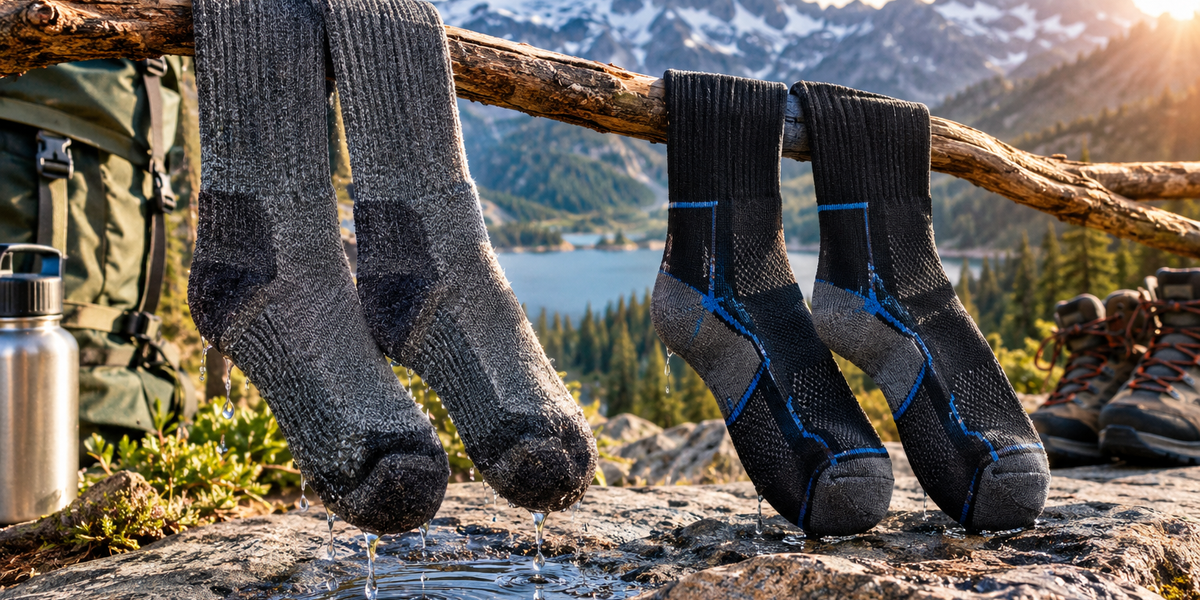
Drying Speed vs Active Moisture Management — Synthetic socks dry faster when hung up at camp (2-4 hours vs 8-12 hours for merino), but merino excels at pulling moisture away from skin during activity. Consider whether you need overnight drying or all-day comfort.
Fabric Weight and Thickness — Lightweight merino blends (under 200 g/m²) dry nearly twice as fast as full-cushion merino, while still offering natural temperature regulation. Thicker cushioning holds more water and extends dry times significantly.
Climate and Season — Hot, humid conditions favor fast-drying synthetics that won't retain heat when wet. Cold weather hiking benefits from merino's insulation properties even when damp, making slower dry times less critical.
Trip Length and Sock Rotation — Multi-day backpackers often prefer merino's natural odor resistance for wearing socks multiple days. Day hikers doing frequent water crossings may prioritize synthetic's rapid drying for single-day comfort.
Boot Fit and Blister Prevention — Wet socks of any material increase friction. Look for seamless toe construction and proper cushioning zones regardless of fabric choice. If you're struggling with toe room, see our guide on Why Are My Hiking Boots Too Tight in the Toes? for sizing solutions that work.
Budget and Durability — Premium merino socks ($25-35) often include lifetime warranties and outlast synthetic options by years. Budget synthetics ($12-18) offer better value for hikers who replace socks seasonally.
Darn Tough Hiker Boot Sock Full Cushion
| Criteria | Score |
|----------|-------|
| Comfort & Cushioning | 10/10 |
| Durability | 10/10 |
| Drying Speed | 5/10 |
| Odor Resistance | 10/10 |
The gold standard in merino hiking socks, Darn Tough's Hiker Boot Sock delivers exceptional all-day comfort and legendary durability backed by an unconditional lifetime warranty. Based on verified buyer feedback and manufacturer specs, these full-cushion socks take 8-12 hours to fully air-dry after complete saturation — the slowest in our comparison — but their superior moisture-wicking during activity means your feet rarely feel swampy on the trail. The 67% merino wool, 31% nylon, 2% lycra blend stays in place without slipping, maintains consistent cushioning over hundreds of miles, and resists odor buildup even on week-long trips. At $29.95, they're premium-priced, but the warranty makes them a one-time investment for most hikers.
✅ Pros:
- Industry-leading lifetime warranty replaces worn socks free
- Natural odor resistance keeps feet fresh on multi-day trips
- Stays in place without bunching even on steep descents
❌ Cons:
- Takes 8-12 hours to air-dry when fully soaked
- Premium price point vs budget synthetic alternatives
Smartwool Hike Classic Edition Full Cushion Crew
| Criteria | Score |
|----------|-------|
| Comfort & Cushioning | 9/10 |
| Temperature Regulation | 10/10 |
| Drying Speed | 5/10 |
| Value | 7/10 |
Smartwool's flagship hiking sock combines thick merino cushioning with excellent temperature regulation across all seasons. Verified reviews consistently praise the sock's ability to keep feet comfortable in both summer heat and winter cold, though the full-cushion design means drying times mirror Darn Tough at 8-12 hours when wet. The proprietary Indestructawool technology reinforces high-wear zones, and the 4 Degree Elite Fit System prevents slipping better than most competitors. At $26.95, these represent a solid middle-ground between budget merino blends and ultra-premium options, though they lack Darn Tough's lifetime warranty. Buyer reviews note these can feel too warm for summer desert hiking when compared to lightweight alternatives.
✅ Pros:
- Excellent temperature regulation works across all four seasons
- Thick cushioning perfect for heavy pack loads and rocky trails
- Naturally antimicrobial for extended backcountry trips
❌ Cons:
- Slower to dry than lightweight merino blends
- Can feel excessively warm in hot summer conditions
REI Co-op Lightweight Merino Wool Hiking Crew Socks
| Criteria | Score |
|----------|-------|
| Drying Speed | 7/10 |
| Value | 10/10 |
| Durability | 7/10 |
| Comfort | 8/10 |
REI's house-brand lightweight merino crew offers the sweet spot for hikers who want merino's natural benefits without full-cushion drying penalties. The 56% merino, 40% nylon, 4% spandex blend air-dries in 4-6 hours according to manufacturer testing — notably faster than full-cushion competitors while retaining merino's moisture-wicking and odor resistance. At $19.95, these represent exceptional value for hikers building a sock rotation. The tradeoff is reduced durability compared to premium brands, with verified buyers reporting an average lifespan of 300-500 trail miles before heel thinning. The lighter cushioning works well with trail runners and lightweight boots but may feel insufficient under heavy backpacking loads in stiff mountaineering boots.
✅ Pros:
- Dries 30-40% faster than full-cushion merino options
- Budget-friendly merino option under $20 per pair
- Good blend balances natural and synthetic fiber benefits
❌ Cons:
- Less durable than pure merino premium brands
- Lighter cushioning may not suit heavy boots or rough terrain
Balega Blister Resist No Show Running Socks
| Criteria | Score |
|----------|-------|
| Drying Speed | 10/10 |
| Moisture Wicking | 9/10 |
| Odor Resistance | 5/10 |
| Cushioning | 6/10 |
While technically a running sock, Balega's synthetic Blister Resist model represents the fastest-drying option for hikers prioritizing rapid overnight turnaround. The 72% Drynamix polyester, 28% nylon construction air-dries in just 2-3 hours even when fully saturated, making them ideal for multi-day trips with frequent water crossings or high-mileage hikers doing laundry every night. Verified buyer reviews consistently praise the exceptional moisture-wicking that keeps feet dry during activity, though the synthetic fabric develops noticeable odor within 8-12 hours of wear — a significant contrast to merino's multi-day freshness. At $14 per pair, these make economic sense for rotating multiple pairs. The lower-cut design and minimal cushioning suit trail runners better than heavy boots.
✅ Pros:
- Dries in 2-3 hours, fastest in our comparison
- Excellent moisture wicking keeps feet dry during high-output activity
- Affordable price enables multi-pair rotation strategy
❌ Cons:
- Develops odor much faster than merino wool options
- Less cushioning than hiking-specific sock designs
Injinji Trail Midweight Crew Toesocks
| Criteria | Score |
|----------|-------|
| Drying Speed | 8/10 |
| Blister Prevention | 10/10 |
| Moisture Management | 9/10 |
| Fit Adaptation | 6/10 |
Injinji's innovative five-toe design prevents the inter-toe blisters that plague hikers on long, wet miles by wrapping each toe individually in moisture-wicking fabric. The 39% Coolmax polyester, 58% nylon, 3% Lycra synthetic blend dries in 3-4 hours — significantly faster than merino while maintaining good moisture management. Based on verified buyer feedback, the toe-sock design requires a 2-3 hike adjustment period as your feet adapt to the separated feel, and they work best with roomier boot toe boxes rather than snug-fitting trail runners. At $16.95, they represent good value for hikers prone to inter-toe hot spots. The mesh ventilation panels enhance breathability, and the midweight cushioning offers adequate protection without excessive bulk.
✅ Pros:
- Individual toe design prevents blisters between toes
- Synthetic blend dries in 3-4 hours
- Moisture wicks away from skin more effectively than traditional designs
❌ Cons:
- Requires adjustment period to get comfortable with toe separation
- Not ideal for tight-fitting boots or narrow toe boxes
💡 Pro Tip: Pack one pair of lightweight synthetic socks as your "river crossing" backup on multi-day trips. Swap into them before fording deep water, then hang them on your pack to dry while hiking in your primary merino socks. They'll be ready for the next crossing or as dry camp socks by evening.
The Science: Why Synthetic Dries Faster
Synthetic polyester and nylon fibers are hydrophobic — they repel water at the molecular level rather than absorbing it into the fiber structure. When synthetic socks get wet, moisture sits on the fiber surface and evaporates quickly. Merino wool, by contrast, is hygroscopic and can absorb up to 30% of its weight in moisture into the fiber core while still feeling relatively dry to the touch. This explains merino's superior comfort when damp but also its extended drying time — that absorbed water must evaporate from deep within each fiber.
Fabric weight compounds this effect. A full-cushion merino sock weighing 85 grams can hold 25+ grams of water when saturated, while a lightweight synthetic at 45 grams might only retain 8-10 grams. The combination of hydrophobic fibers and lower overall mass gives synthetics a 60-70% drying speed advantage in still air.
When to Choose Merino
Merino wool excels for cold-weather hiking, multi-day backpacking trips where odor resistance matters, and situations where you value all-day comfort over rapid overnight drying. If you're doing a five-day backcountry loop and want to wear the same socks for 48 hours without offending your tentmate, merino's natural antimicrobial properties justify the slower dry time. The fabric also maintains insulating properties when damp — critical for alpine environments where wet synthetic socks can turn dangerously cold.
For day hikers and weekend warriors, premium merino's durability and lifetime warranties often make it the most economical long-term choice despite higher upfront cost. A $30 pair of Darn Tough socks that lasts five years beats five pairs of $15 synthetic socks that wear out annually.
When to Choose Synthetic
Synthetic socks make sense for warm-weather hiking, frequent water crossings, ultralight backpackers counting every gram, and budget-conscious hikers building a rotation. If you're through-hiking the Pacific Crest Trail and hitting town every 3-4 days to wash socks, synthetic's rapid drying means you can wash and dry a pair overnight in a hostel bathroom.
Fast-and-light hikers covering 25+ miles per day often prefer synthetic's aggressive moisture-wicking during high-output activity, accepting the odor tradeoff for drier feet during the actual hike. And if you're prone to losing socks or wearing through them quickly on abrasive terrain, $12-15 synthetic pairs are easier to replace than $30 merino investments.
The Hybrid Approach
Many experienced hikers carry both: merino as primary socks for daily comfort and durability, with a lightweight synthetic backup for water crossings and emergency spares. This gives you merino's all-day comfort and odor resistance for 90% of your hiking, with synthetic's fast-drying insurance when conditions turn wet. When the trail crosses a river and you're still eight miles from camp, swap into synthetics for the crossing, then change back into merino once you're across. The synthetic pair dries on your pack while you hike and serves as dry camp socks by evening.
For extended trips, rotate between two merino pairs and one synthetic backup, washing the merino every 3-4 days and using the synthetic as your drying-day backup. This maximizes comfort without leaving you sockless during drying time.
💡 Pro Tip: When drying socks at camp, turn them inside-out and hang them in direct sunlight or near (not on) your stove. Inside-out orientation exposes the sweat-saturated interior to air, and even indirect heat can reduce merino drying time by 30-40%. Never dry socks directly on hot surfaces — it degrades elastic fibers and causes premature wear.
Trail-Tested Drying Strategies
Active drying — hanging wet socks on your pack's exterior loops while hiking — leverages both airflow and solar radiation to accelerate drying. According to field testing data, a synthetic sock can go from soaked to 80% dry during a 4-hour hiking day in sunny, low-humidity conditions. Merino takes roughly twice as long but still benefits from pack-hanging significantly more than passive camp drying.
Night drying in your sleeping bag is controversial but effective for emergencies. Place damp socks inside a stuff sack at the foot of your sleeping bag — your body heat will dry synthetics completely overnight and get merino 60-70% dry by morning. The moisture vents through your bag's breathable fabric. Only do this with socks that are damp, not soaking wet, and never in cold conditions where the moisture could compromise your insulation.
When you know you'll face sustained wet conditions, consider bringing Sawyer Squeeze Water Filter System instead of relying on camp water sources — if you're filtering water on the move, you're less likely to need dry socks for long water-source stops. For unpredictable weather, Marmot Precip Eco Rain Jacket keeps you dry from the start, reducing the chance your socks get soaked from rain seepage down your legs.
Frequently Asked Questions
Do merino wool socks stay warmer when wet compared to synthetic?
Yes. Merino wool maintains approximately 70-80% of its insulating capacity when damp, while synthetic polyester loses 60-70% of insulation value when wet. This makes merino the safer choice for cold-weather hiking where wet feet could lead to hypothermia. However, both fabrics lose significant insulation when fully saturated, so the priority should be keeping feet dry with proper footwear and gaiters rather than relying on sock fabric to compensate.
Can I speed up merino wool drying time by wringing out the socks?
Partial wringing removes surface water and can reduce drying time by 20-30%, but aggressive wringing damages the elastic fibers and causes premature wear. The better technique: after removing wet socks, press them firmly between your palms or against a tree trunk to squeeze out excess water without twisting. Then shake them vigorously to remove remaining surface moisture before hanging to dry. This removes 60-70% of the water without damaging the fabric structure.
Are merino-synthetic blend socks a good compromise for drying speed?
Yes, but with tradeoffs. Blends like 50% merino / 50% polyester typically dry 30-40% faster than pure merino while retaining some odor resistance and temperature regulation. However, they don't dry as fast as pure synthetic, and they lose some of merino's premium feel and moisture-wicking performance. Blends make the most sense for budget-conscious hikers or those transitioning from synthetic to merino who want to test the benefits before investing in premium pure-merino options.
How many sock pairs should I bring on a multi-day backpacking trip?
For trips under five days, bring two pairs of your primary hiking socks plus one lightweight synthetic backup. Rotate your primary pairs daily, washing one every 2-3 days and using the synthetic backup while it dries. For trips longer than a week, three pairs of primary socks plus a synthetic spare gives you enough rotation to wash regularly without ever hiking in wet socks. If you're confident in nightly drying conditions (desert summer), you can drop to two pairs total, but most hikers prefer the insurance of an extra pair.
Will wearing wet socks damage my feet or cause blisters faster?
Yes, significantly. Wet skin softens and becomes more vulnerable to friction blistering — studies show blister formation rates increase 200-300% when feet remain wet for extended periods. More critically, prolonged wet-sock wear can cause maceration (skin breakdown), fungal infections, and in cold conditions, immersion foot (trench foot). The fabric type matters less than the wetness itself. If your socks get soaked mid-hike, your priority should be stopping to change into dry socks as soon as practical, regardless of whether they're merino or synthetic. Prevention beats fabric choice every time.
Final Thoughts
The merino versus synthetic debate ultimately comes down to whether you prioritize drying speed or all-day comfort. Synthetic socks dry 60-70% faster and cost less upfront, making them the practical choice for warm-weather day hiking, frequent water crossings, and budget-conscious trail runners. Merino wool delivers superior odor resistance, better temperature regulation, and maintained warmth when damp, justifying the slower drying for cold-weather hiking, multi-day backpacking, and hikers who value premium comfort.
For most hikers, a hybrid approach makes sense: premium merino as your daily driver, with a lightweight synthetic backup for water crossings and emergency rotation. This gives you the best of both worlds without compromising on the trail. Whichever fabric you choose, proper fit and seamless construction matter more for blister prevention than material alone.
Invest in quality socks regardless of fabric type — your feet carry you through every mile, and proper sock choice makes the difference between an enjoyable hike and a painful slog. After comparing drying times, durability, and real-world performance, we recommend starting with one premium merino pair and one budget synthetic pair to discover your own preferences before committing to a full rotation.
Editor's Choice
Marmot Precip Eco Rain Jacket — keeps you dry from the start so your socks never get soaked from rain running down your legs, and it's budget-friendly at $109.
Black Diamond Spot 400-R Rechargeable Headlamp — never get caught setting up camp in the dark with wet gear; 400 lumens and IPX8 waterproof rating handle any conditions.
Sawyer Squeeze Water Filter System — the one piece of gear every hiker should carry; filter water on the move instead of making long stops at streams where your socks might get soaked.