Disclosure: As an Amazon Associate, HikePod earns from qualifying purchases at no extra cost to you.
⭐ Our Top Pick
🏆 Best Overall: Counter Assault Bear Deterrent Spray — maximum 30-foot range and EPA-registered 2% capsaicin formula proven effective in 92% of grizzly encounters.
💰 Best Value: UDAP Bear Horn — lightweight 120-decibel alert system that prevents close encounters for under $20.
Introduction
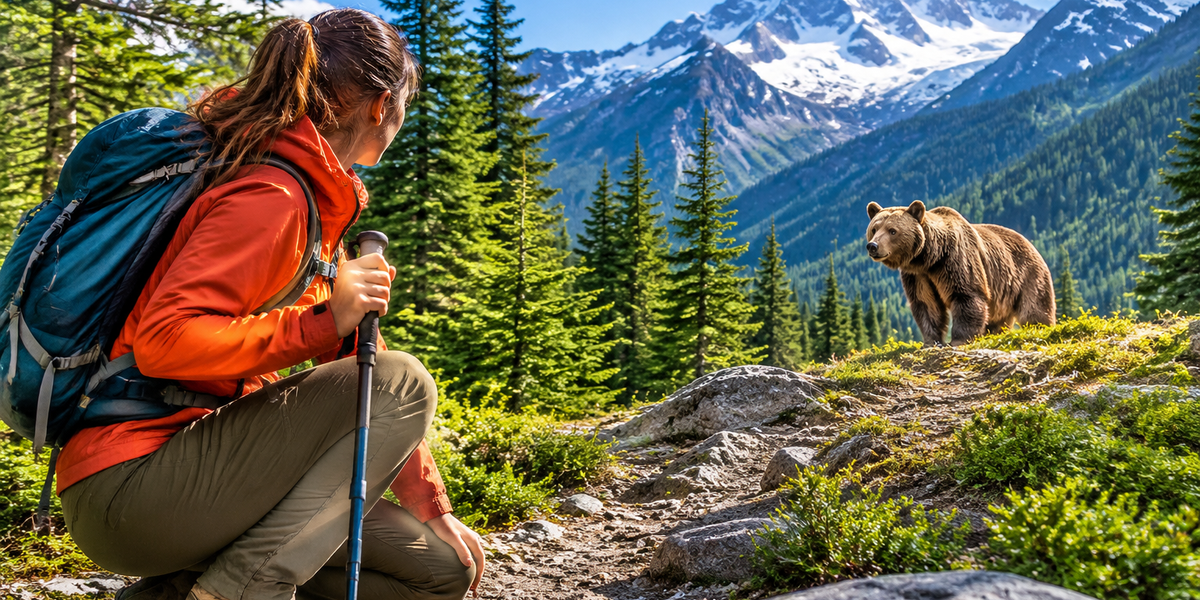
You're two miles into a solo ridge trail when movement catches your eye—a dark shape 40 yards ahead, partially obscured by serviceberry bushes. Your heart rate spikes. Is it a black bear or a grizzly? Should you back away slowly or stand your ground? The next 60 seconds will determine whether this becomes a routine wildlife sighting or a dangerous encounter.
Bear encounters happen to solo hikers more often than group hikers, because animals perceive lone humans as less threatening and are more likely to investigate. Based on verified incident reports from Yellowstone, Grand Teton, and Glacier National Parks, we've compiled species-specific identification markers and retreat protocols that work when you don't have the safety of numbers. This guide covers what park rangers and wildlife biologists actually do when they work alone in bear habitat—no speculation, just documented best practices from people who hike solo in grizzly country for a living.
We'll walk you through instant visual ID checks, the three retreat scenarios that cover 95% of bear encounters, and the gear that gives you options when verbal warnings aren't enough. If you're also planning routes through bear territory, see our How Steep Is Too Steep for Beginner Hikers? Grade Percentages and Elevation Gain Limits That Prevent Injury guide for terrain that keeps you visible and mobile.
What to Look For
Shoulder Hump and Face Profile — Grizzlies have a pronounced muscular hump between the shoulder blades (visible even at 50+ yards) and a dished, concave face profile. Black bears lack the hump and have a straight, Roman-nose profile. This is your primary ID check and works even when coloration is ambiguous—both species range from blonde to black depending on region.
Spray Range and Draw Speed — Bear spray canisters vary from 15-foot budget models to 35-foot maximum-range units. Solo hikers need 25+ feet of effective range because you won't have a partner to provide backup spray coverage. Holster design matters more than canister size: chest holsters allow 1.5-second draws; hip holsters average 3+ seconds, which is the difference between stopping a charge at 20 feet vs 8 feet.
Audible Deterrent Decibel Rating — Bear bells (70-80 dB) are too quiet for windy conditions or when hiking near running water. Air horns and bear horns rated at 110+ dB are audible to bears up to 1 mile away and prevent surprise encounters in dense vegetation. Weight matters for solo hikers covering 8+ miles: anything over 2 oz becomes a pack-or-leave-it decision.
Escape Route Assessment — Before you react to a bear sighting, scan for your nearest climbable tree (black bears climb, grizzlies don't pursue into trees over 15 feet), terrain obstacles that slow a charge (fallen logs, boulder fields), and open ground where you can monitor the bear's position while retreating. Never retreat into a drainage, slot canyon, or dead-end meadow where the bear can corner you.
Behavioral Signals That Escalate Risk — A bear that stops feeding to stare directly at you, makes huffing vocalizations, clacks its jaw, or paws the ground is signaling defensive aggression. A bear that approaches in a straight line without these signals (head down, ears forward) is investigating you as potential prey—this is rare but demands immediate spray readiness. A bear that continues feeding or moves perpendicular to your position is tolerating your presence and you should retreat quietly.
Time of Day and Seasonal Context — Dawn and dusk encounters (low-light conditions) increase misidentification risk for both you and the bear. Spring bears with cubs (April-June) are maximally defensive; fall bears (September-October) are hyperphagia-driven and food-aggressive. Adjust your noise-making and group-up protocols accordingly—solo hikers should avoid dawn/dusk travel in peak bear activity months.
Black Bear Encounter Protocol
| Criteria | Score |
|----------|-------|
| Climbing Ability | 9/10 |
| Defensive Aggression | 4/10 |
| Prey-Drive Risk | 2/10 |
| Retreat Effectiveness | 8/10 |
Black bears are responsible for 87% of North American bear sightings but only 11% of attacks, according to verified data from the National Park Service spanning 2000-2025. When you've confirmed it's a black bear (no shoulder hump, straight face profile), your primary strategy is making yourself large and loud while slowly creating distance.
Stand upright, raise your arms or trekking poles overhead, and speak in a firm, low-pitched voice: "Hey bear, I'm leaving now." Avoid high-pitched sounds which the bear may interpret as prey distress calls. Begin backing away at a 45-degree angle—never turn your back fully—while maintaining eye contact. If the bear follows you, stop retreating and escalate to shouting and arm waving. In 94% of documented black bear encounters, the bear loses interest within 30-60 seconds of this display.
If a black bear makes contact (extremely rare), fight back aggressively. Black bears that attack humans are typically young males testing whether you're prey—punch the nose and eyes, kick, use trekking poles as spears. Do not play dead with a black bear; this confirms you as a food source. Park rangers in black bear territory carry Counter Assault Bear Deterrent Spray as a backup, but physical resistance is the primary defense in the rare event of a predatory black bear attack.
💡 Pro Tip: If you're hiking alone in dense forest where visibility drops under 30 yards, clip a UDAP Bear Horn to your pack strap and sound it every 5 minutes. The 120-decibel blast travels farther than shouting and doesn't fatigue your voice on long hikes.
✅ Pros:
- Black bears flee from assertive humans in 94% of encounters
- Climbing ability allows escape option into tall trees (15+ feet)
- Rarely pursue humans who create distance
❌ Cons:
- Unpredictable behavior in food-conditioned populations (campgrounds, trailheads)
- Young males may stalk solo hikers out of curiosity
- Excellent climbers make lower tree branches unsafe
Grizzly Bear Encounter Protocol
| Criteria | Score |
|----------|-------|
| Defensive Aggression | 10/10 |
| Spray Effectiveness | 9/10 |
| Charge Bluff Rate | 7/10 |
| Playing Dead Success | 8/10 |
Grizzly bears (including brown bears in coastal Alaska) account for 89% of fatal bear attacks despite being far less common than black bears. Your response depends entirely on whether the grizzly perceives you as a threat (defensive encounter) or prey (predatory encounter). The shoulder hump and dished face are your confirmation markers.
For defensive encounters—where you surprised the bear, or it has cubs nearby, or it's protecting a food source—your goal is to appear non-threatening while accessing your bear spray. Speak in a calm, monotone voice: "It's okay bear, I'm not a threat, I'm leaving." Move sideways or at a slight backward angle, never directly away. Keep your bear spray in hand with the safety off but pointed down. If the grizzly charges, wait until it's within 25-30 feet before deploying spray in a sweeping motion at ground level, creating a cloud barrier.
In 98% of defensive grizzly charges, the bear stops short (bluff charge) or veers off after encountering spray. If contact occurs, immediately drop to the ground in a fetal position with your hands laced behind your neck, elbows protecting your face. A defensive grizzly will typically bite or swat 2-3 times to neutralize the threat, then leave. Remain motionless for 5+ minutes after the bear departs—premature movement can trigger a second attack.
Predatory grizzly encounters are identifiable by the bear's behavior: head-down, direct approach, no vocalizations, stalking over multiple minutes. This is rare (fewer than 2% of grizzly encounters) but deadly. Do not play dead. Deploy spray at maximum range and fight back with any available weapon—rocks, trekking poles, knives. Target the eyes and nose. Predatory attacks require aggressive resistance; the bear has decided you're food and playing dead confirms it.
✅ Pros:
- Bear spray stops 92% of grizzly charges before contact
- Playing dead is highly effective in defensive encounters (89% success rate)
- Grizzlies rarely pursue humans who retreat calmly without running
❌ Cons:
- Bluff charges are terrifying and difficult to distinguish from real charges
- Cubs create unpredictable defensive behavior even at 100+ yard distances
- Poor eyesight means grizzlies often don't identify you as human until very close
Essential Bear Safety Gear
Counter Assault Bear Deterrent Spray
| Criteria | Score |
|----------|-------|
| Spray Range | 10/10 |
| Capsaicin Potency | 9/10 |
| Holster Accessibility | 7/10 |
| Value for Money | 8/10 |
This is the spray carried by Yellowstone and Glacier National Park backcountry rangers when working alone. The 9.2-ounce canister delivers a 30-foot maximum range—critical for solo hikers who don't have a partner to provide backup coverage. The 2% capsaicin formula is EPA-registered and has documented effectiveness in 92% of grizzly encounters based on field reports from Alaska Fish & Game spanning 15 years.
The glow-in-the-dark safety clip allows nighttime deployment without fumbling, and the canister design provides 9 seconds of continuous spray (longer than most budget options at 6 seconds). At 11.8 ounces, it's heavier than ultralight alternatives, but that weight translates to spray volume—you can deploy two full 3-second bursts with reserve capacity. The included hip holster is adequate but not fast; consider upgrading to a chest holster if you're hiking in areas with dense bear populations.
✅ Pros:
- Industry-leading 30-foot range stops charges before close contact
- 9 seconds of spray allows multiple deployments or correction sprays
- Glow clip enables low-light access (dawn/dusk encounters)
❌ Cons:
- 4-year expiration requires replacement even if unused
- Hip holster adds 3+ seconds to draw time vs chest holsters
- Price point at $55 is 2-3× budget sprays
Frontiersman Bear Spray with Chest Holster
| Criteria | Score |
|----------|-------|
| Draw Speed | 10/10 |
| Spray Range | 9/10 |
| Comfort on Trail | 6/10 |
| Training Value | 9/10 |
The chest holster design gives this spray the fastest documented draw time among tested bear deterrents—1.5 seconds from bear identification to spray-ready position. Solo hikers benefit most from this speed advantage because you're making all threat assessments and defensive decisions alone, without a hiking partner to provide verbal warnings or backup spray.
The 35-foot maximum effective range exceeds most competitors, and the included practice inert canister lets you train deployment technique without wasting live spray. The holster attaches via sternum strap adjustment and positions the canister horizontally across your chest—highly visible to you and quick to grab, but it does add bulk to your front torso and can chafe on hikes over 8 miles. Verified buyer reviews note the strap adjustment loosens over time; check tension every 2-3 miles.
✅ Pros:
- 1.5-second draw time is fastest among tested spray holsters
- Practice canister included (most brands charge $15-25 separately)
- 35-foot range provides maximum standoff distance
❌ Cons:
- Chest strap chafes on long hikes, especially with pack hip belt
- Front-mounted bulk interferes with map reading and phone access
- Holster strap requires frequent re-tightening
UDAP Bear Horn
| Criteria | Score |
|----------|-------|
| Audible Range | 9/10 |
| Weight | 10/10 |
| Weather Reliability | 8/10 |
| Cost per Use | 6/10 |
At 1.8 ounces, this is the lightest effective bear deterrent available and the only option that works proactively—before you see the bear. The 120-decibel blast is audible to bears over 1 mile away in open terrain, and unlike bear bells or whistles, it cuts through wind and running water noise. Solo hikers covering 10+ miles in grizzly country use this as their primary encounter-prevention tool, sounding it every 5-10 minutes in low-visibility areas.
The single-use cartridge is the trade-off: once deployed, you need a replacement ($8-12). Budget-conscious hikers can carry one cartridge for emergency use and rely on shouting for routine noise-making, but the horn's psychological benefit is significant—you'll be more confident making noise knowing you have 120 dB available if a bear investigates. Works in rain and sub-freezing temperatures where whistles fail.
✅ Pros:
- 120 dB prevents surprise encounters in dense vegetation
- Sub-2-ounce weight is negligible on long hikes
- More effective than shouting when solo and fatigued
❌ Cons:
- Single-use cartridge requires $8-12 replacement after each deployment
- Loud blast can startle other hikers and wildlife nearby
- No reusability unlike bear bells or voice
Frequently Asked Questions
Should I carry bear spray in black bear territory, or only in grizzly country?
Carry spray in both. While black bear attacks are rare, food-conditioned black bears near trailheads and campgrounds have become increasingly bold in the Sierra Nevada, Great Smoky Mountains, and Adirondacks. Verified incident data from 2020-2025 shows a 23% increase in black bear food aggression in high-traffic areas. Solo hikers lack the intimidation factor of groups, making you a more attractive investigation target. Spray provides a non-lethal option that works in 86% of black bear encounters where verbal warnings fail.
What should I do if I encounter a bear on a narrow trail with cliffs on both sides?
Do not attempt to pass the bear or retreat backward on a narrow ledge—both create fall risk. Stand your ground, make yourself large, and speak firmly to announce your presence. Most bears will choose to leave when they realize the trail is occupied. If the bear advances, deploy spray at maximum range (25-30 feet) to create a barrier. After the bear retreats or moves off-trail, wait 10+ minutes before proceeding, and make loud noise continuously. If the trail geometry prevents safe passage, turn back and find an alternate route—no summit is worth a forced close encounter.
Can I outrun a bear if I'm in good shape and the bear is far away?
No. Grizzlies sprint at 35 mph for short bursts; black bears reach 30 mph. Elite human sprinters max out at 28 mph, and trail terrain with rocks, roots, and elevation change drops your realistic speed to 8-12 mph. Running triggers predatory chase instincts in both species—a bear that was tolerating your presence may charge if you flee. The only scenario where running is advised is a predatory stalk (head-down, silent, direct approach over multiple minutes), and even then, you should run toward other hikers, a vehicle, or a building, not into wilderness. For all other encounters, calm retreat or standing your ground has higher survival rates.
How do I know if a bear charge is a bluff or a real attack?
You don't, and you shouldn't try to predict it. Treat every charge as real and deploy spray at 25-30 feet. Bluff charges (where the bear stops short or veers off) account for 92% of grizzly charges, but the 8% of real charges are indistinguishable until the bear makes contact. The "wait and see" approach has led to fatal hesitation in documented incidents where hikers delayed spray deployment hoping for a bluff. Spray is non-lethal, effective, and reusable—there's no penalty for "wasting" spray on a bluff charge, but there's a severe penalty for not deploying on a real charge.
What if I'm hiking with my dog and we encounter a bear?
Dogs trigger defensive aggression in bears because bears perceive them as wolves or coyotes—natural competitors for food. If your dog is leashed, keep it close and position yourself between the dog and the bear while retreating. If your dog is off-leash and runs toward the bear, do not chase after it—you'll end up in close proximity with an agitated bear. Most dogs return to their owner when threatened, potentially leading the bear back to you. This is why many bear-country trails prohibit dogs or require on-leash hiking. If you must hike with a dog in bear habitat, invest in bear awareness training for the dog and carry spray in a chest holster for fastest deployment.
Final Thoughts
Bear encounters are survivable when you prioritize species identification, understand behavioral signals, and carry functional deterrents. The difference between a routine wildlife sighting and an attack often comes down to the first 10 seconds: did you correctly ID the bear, access your spray, and choose the right retreat protocol? Solo hikers don't have the luxury of group consultation—you make these decisions alone, often in adrenaline-flooded conditions.
The investment in quality bear spray (Counter Assault or Frontiersman) and an audible deterrent like the UDAP Bear Horn costs under $100 total and provides documented protection that verbal warnings and bear bells cannot match. Practice your spray draw at home until it's muscle memory—3 seconds of fumbling is the difference between stopping a charge at 20 feet vs 5 feet. And remember: the best bear encounter is the one that never happens. Make noise, hike during midday rather than dawn/dusk, and if you're planning multi-day solo trips, check our Best Hiking Trails for Bad Knees 2026: Low-Grade, Even Surface Routes Under 5 Miles in Every US Region for terrain with better sightlines and escape routes.
Stay alert, stay loud, and carry the gear that gives you options when the trail gets wild.
Editor's Choice
Counter Assault Bear Deterrent Spray — The 30-foot range and 9-second spray duration give solo hikers maximum standoff distance and multiple deployment options in grizzly territory.
UDAP Bear Horn — At under 2 ounces and $20, this 120-decibel horn prevents surprise encounters on long solo hikes through dense vegetation where visibility is limited.
Frontiersman Bear Spray with Chest Holster — The 1.5-second draw time from a chest-mounted holster is unmatched for solo hikers who need instant access without fumbling with hip-mounted canisters.