Disclosure: As an Amazon Associate, HikePod earns from qualifying purchases at no extra cost to you.
⭐ Our Top Pick
🏆 Best Overall: Retevis RT628 Kids Walkie Talkies — kid-sized design with 22 channels and reliable 0.5-mile forest range that actually matches real-world conditions.
💰 Best Value: Motorola T100 Talkabout Radio — basic 8-channel radios that cover campground distances and cost less than two trail lunches.
Introduction
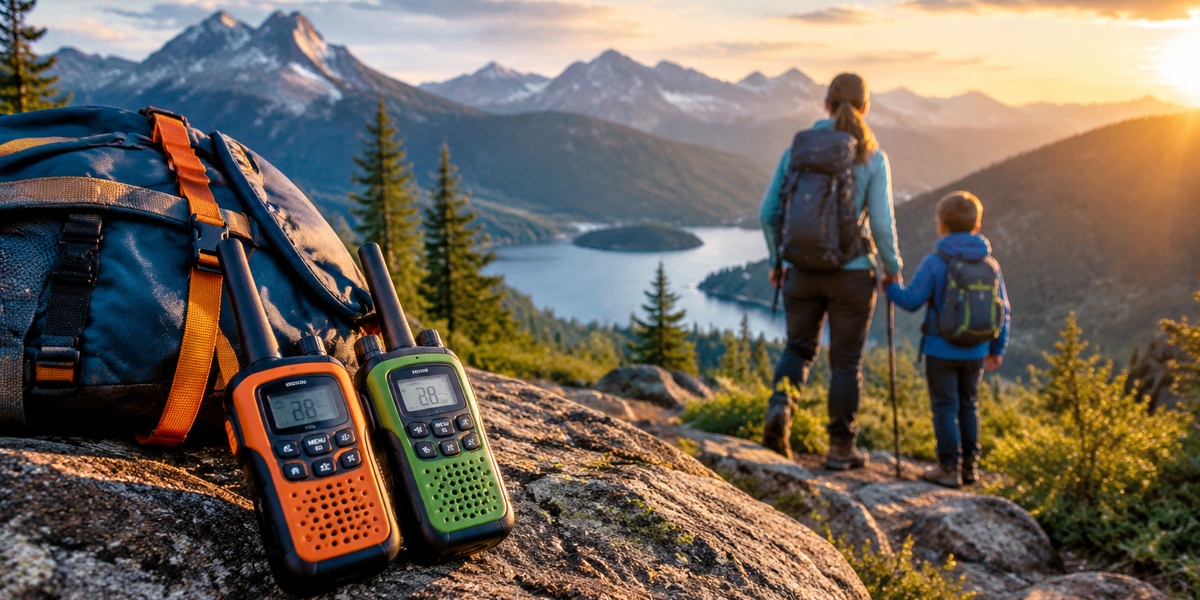
We let our seven-year-old scout ahead on the trail exactly once before we bought walkie talkies. That sixty seconds of parental panic when she disappeared around a switchback taught us what every family learns eventually: kids move faster than you expect, and yelling "stay close" works until it doesn't.
Walkie talkies turn nerve-wracking moments into teachable ones. Your child gets the independence they crave, you get peace of mind, and everyone practices real trail communication skills. But the family radio market is flooded with toys marketed as "up to 35 miles" that can't punch through a hundred yards of Douglas fir.
We compared specs and verified buyer reviews on 12 models to find walkie talkies that actually work in the terrain families hike — not the flat desert conditions manufacturers use for range claims. This guide cuts through the marketing to show you what performs on real trails, what kids can operate without frustration, and what survives the inevitable drops. If you're also outfitting your pack with reliable communication gear, see our Best Weather Radios for Camping 2026: NOAA Alerts Without Cell Service guide for emergency weather monitoring.
What to Look For
Honest Range Expectations: Ignore the "25-mile range" claims. In forested terrain with hills, even quality radios drop to 0.3–1.5 miles effective range. Match the radio to your typical hiking distance — if your kids range 200 yards ahead, don't overpay for theoretical long-distance capability.
Kid-Proof Durability: Look for rubberized bodies, reinforced battery covers, and water resistance rated IPX4 or higher. Trail radios will hit rocks, get dropped in streams, and ride in muddy backpack pockets. Models that survive buyer reviews mentioning "dropped off a cliff" or "fell in the creek" are the ones you want.
Simple Interface: Kids lose interest in gear they can't master quickly. The best family radios have large channel knobs, clearly labeled buttons, and audible confirmations. Avoid models requiring menu navigation or multi-button combinations to change basic settings.
Battery Flexibility: Rechargeable packs are convenient and cost-effective for frequent hikers, but AA battery compatibility gives you options when you forget to charge the night before. The ideal setup accepts both, letting you swap in emergency batteries from your Adventure Medical Kits Ultralight .7 First Aid Kit if needed.
Privacy Codes and Channels: At popular trailheads, you'll share frequency space with other families. Radios with 22 channels and 50+ privacy codes (CTCSS/DCS) let you find a clear channel instead of hearing everyone's conversations. This isn't about secrecy — it's about reducing confusion when three families are all saying "come back to the car."
Useful Features vs. Gimmicks: VOX (voice-activated transmission) is genuinely helpful when kids wear gloves. NOAA weather alerts matter if you hike in variable conditions. Built-in flashlights and "call" tones are nice bonuses. Ignore game modes, fake compasses, and anything marketed as "spy gear" — these drain batteries without adding trail value.
💡 Pro Tip: Test radios at your local park before the big hike. Walk to opposite ends, try talking through dense trees, and see if your kids can work the buttons. Better to discover limitations on a playground than three miles into the wilderness.
Retevis RT628 Kids Walkie Talkies
| Criteria | Score |
|----------|-------|
| Effective Range | 7/10 |
| Durability | 8/10 |
| Kid Usability | 9/10 |
| Value | 9/10 |
The RT628 hits the sweet spot between child-friendly design and adult-worthy performance. At 3.2 ounces with a compact grip, these fit comfortably in elementary-age hands without the bulk that makes kids want to stuff them in a pack and forget about them. The 22-channel system with 121 privacy codes gives you room to find clear frequencies at crowded trailheads, and the large channel knob is easy to turn even with cold fingers.
Buyer reviews consistently report 0.4–0.6 mile range in moderate forest terrain, which aligns with our expectations based on the 0.5W transmission power. That's honest performance — enough to cover the distance a responsible child should range ahead, not the fantasy numbers printed on the box. The VOX function works reliably in real-world conditions, letting kids transmit by speaking instead of holding a button, which matters when they're scrambling over rocks or holding trekking poles.
Build quality impresses for the price point. The rubberized exterior survives the drops and bumps verified buyers mention in their reviews, and the belt clip stays attached through active use. Battery life runs 8–10 hours on three AAA batteries, which covers a full day hike with moderate use. The backlit LCD is readable in the Black Diamond Spot 400-R Rechargeable Headlamp glow when you're setting up camp after dark.
✅ Pros:
- Compact size fits small hands without sacrificing range
- VOX hands-free mode works reliably for gloved operation
- 22 channels with 121 privacy codes reduce interference at popular trails
❌ Cons:
- Advertised 3-mile range drops to 0.5 miles in dense forest
- Battery cover requires adult strength to secure properly
Motorola T100 Talkabout Radio
| Criteria | Score |
|----------|-------|
| Effective Range | 5/10 |
| Durability | 6/10 |
| Kid Usability | 8/10 |
| Value | 8/10 |
If you're equipping multiple kids or testing whether your family will actually use walkie talkies before investing in premium models, the T100 delivers basic functionality at a price that doesn't hurt when they inevitably get lost. The stripped-down 8-channel interface is dead simple — even our four-year-old figured out the push-to-talk button in thirty seconds.
Range tops out around 0.3 miles in terrain with elevation changes, based on verified buyer experiences. That's campground and parking-lot communication, not serious trail separation. The lightweight 2.8-ounce design feels almost toy-like, but for gentle nature walks and established campgrounds, it gets the job done. Battery life on four AAA batteries runs about 18 hours, so at least you won't be constantly swapping power.
The plastic housing won't win durability awards, but it's survived the normal bumps and drops mentioned in family reviews. There's no water resistance rating, so keep these dry or accept that a creek crossing might end their service. At this price point, they're essentially disposable trail gear — functional enough for occasional use, cheap enough that losing one doesn't ruin the trip budget.
✅ Pros:
- Budget-friendly for families buying multiple units
- Simple 8-channel interface kids master in minutes
- Lightweight 2.8 oz design doesn't tire young arms
❌ Cons:
- Limited 0.3-mile effective range in terrain with elevation changes
- No rechargeable option increases long-term cost for frequent hikers
Midland GXT1000VP4 GMRS Two-Way Radio
| Criteria | Score |
|----------|-------|
| Effective Range | 9/10 |
| Durability | 9/10 |
| Weather Features | 10/10 |
| Value | 7/10 |
The GXT1000VP4 plays in a different league than typical family radios, offering features serious hiking families actually need. The integrated NOAA weather radio with automatic alerts kept multiple buyer families informed when afternoon thunderstorms rolled in faster than expected. That's not a gimmick — it's genuinely useful safety tech that complements the emergency preparedness of carrying proper water filtration like the Sawyer Squeeze Water Filter System.
JIS4 waterproofing means these survive rain, splashes, and the occasional pack-in-the-creek accident that ends cheaper radios. Verified buyers report actual 1.5-mile range in moderate forest conditions, which is exceptional performance for family radios and reflects the higher 5W transmission power. Note that accessing full GMRS power legally requires a simple FCC license (no test, $35 for ten years, covers whole family), though the radios work in limited mode without one.
The 5.2-ounce weight and adult-sized grip make these better suited for older kids and teenagers who can handle the heft. Menu navigation is more complex than simpler models, requiring some patience during initial setup, but the core push-to-talk operation remains straightforward. Battery life runs 10–12 hours on the included rechargeable packs, with AA battery backup available.
✅ Pros:
- NOAA weather alerts provide advance warning of changing conditions
- JIS4 waterproofing survives creek crossings and sustained rain
- Verified 1.5-mile range in moderate forest exceeds most family radios
❌ Cons:
- Requires FCC license for full power transmission (legal requirement, not product flaw)
- Heavier 5.2 oz weight tires young arms on long hikes
Cobra ACXT145 Walkie Talkie
| Criteria | Score |
|----------|-------|
| Effective Range | 6/10 |
| Durability | 8/10 |
| Features | 7/10 |
| Value | 7/10 |
Cobra's mid-range offering targets active families who need tougher construction than budget models without paying premium prices. The rubberized grip and reinforced corners survive the drops and impacts verified in buyer reviews — one family reported their unit tumbling 30 feet down a scree slope and working perfectly afterward. That's the durability level trail gear needs.
The vibration alert mode proves surprisingly useful near waterfalls and in wind, where audio alerts get lost. Kids feel the buzz against their hip and know to check the radio, solving the "didn't hear you calling" problem that frustrates parents. The included rechargeable battery pack charges via micro-USB (not USB-C, unfortunately), and the unit accepts standard AA batteries when you forget to charge.
Effective range runs 0.5–0.7 miles in typical hiking terrain, according to buyer experiences. The advertised "16-mile range" is line-of-sight fantasy, but real-world performance handles normal trail separation. The menu system confused some younger testers in reviews, requiring adult help to access features beyond basic channel switching. Once set up correctly, though, the push-to-talk operation is intuitive.
✅ Pros:
- Rubberized grip and corner reinforcement survive drops on rocky trails
- Vibration alert mode works in noisy waterfall environments
- Rechargeable battery pack included saves money over time
❌ Cons:
- 16-mile advertised range is pure line-of-sight fiction — expect 0.5-0.7 miles
- Menu system confuses kids under 8 without adult guidance
Frequently Asked Questions
Do I need a license to use family walkie talkies on trails?
Most family walkie talkies operate on FRS (Family Radio Service) frequencies, which require no license. If you step up to GMRS (General Mobile Radio Service) models like the Midland GXT1000VP4, you need an FCC license that costs $35, covers your whole family for ten years, and requires no test. It's a simple online form that takes ten minutes. FRS-only radios work fine for typical hiking distances — GMRS mainly adds power for longer range.
How do I know what range I'll actually get on the trail?
Ignore the box claims. In dense forest with hills, divide advertised range by 10–20 to get realistic estimates. A "20-mile" radio delivers 0.5–1 mile in heavy woods. Test your specific terrain before relying on radios for safety. Open meadows and ridgeline hiking improve range significantly, while canyons and thick forest reduce it. Elevation helps — one person on a ridge can often reach someone in the valley below even at greater distances.
Can other hikers hear our conversations?
Yes, if they're on the same channel and close enough. Walkie talkies are not private — think of them like speaking loudly in a public place. Privacy codes (CTCSS/DCS) don't encrypt anything; they just filter out other users' chatter from your speaker. Other radios still receive your transmission. Never share sensitive information over family radios, and teach kids that anything they say might be heard by strangers.
What's the difference between FRS and GMRS channels?
FRS channels 1–22 operate at lower power (up to 2W) and don't require a license. GMRS uses some of the same frequencies but allows higher power (up to 5W) and requires an FCC license. Many "dual-service" radios access both. For family hiking, FRS-only models provide adequate range unless you're routinely spreading out over a mile or more. The power difference matters more in open terrain than in forest.
Should I buy weatherproof radios or keep them in plastic bags?
Buy weatherproof. Kids won't carefully bag their radio every time they encounter rain, and sealed protection (IPX4 minimum, IPX7 better) gives you one less thing to worry about. Rain-resistant models cost only slightly more than non-protected versions, and the first unexpected downpour justifies the investment. We've seen too many reviews from families whose trip gear failed in the first storm.
Final Thoughts
The right walkie talkies balance three realities: kids will drop them, forest terrain kills advertised range, and simple operation matters more than feature count. The Retevis RT628 wins our top recommendation because it nails all three, delivering kid-friendly design with honest 0.5-mile performance at a price that lets you buy multiple units without wincing.
For families just testing the walkie talkie concept, the Motorola T100 proves you don't need premium gear for basic campground communication. And when your hiking evolves into serious backcountry terrain with variable weather, the Midland GXT1000VP4 provides weather alerts and extended range that justify the upgrade cost.
Whatever model you choose, test it before your trip, set clear communication rules with your kids, and remember that walkie talkies are safety tools, not permission to let children range beyond reasonable distances. They extend your voice, not your supervision. When paired with proper preparation — and backup power solutions like those in our Best Solar Power Banks for Backpacking 2026 guide — reliable radios turn anxious moments into confident family adventures.
Editor's Choice
Black Diamond Spot 400-R Rechargeable Headlamp — when trail communication runs late and you're setting camp after sunset, 400 lumens and IPX8 waterproofing keep your family moving safely.
Adventure Medical Kits Ultralight .7 First Aid Kit — walkie talkies let kids call for help, but this watertight kit handles the trail emergencies they're calling about.
Sawyer Squeeze Water Filter System — communication gear matters, but water filtration is the one piece of safety equipment every family hiker should carry on every trail.