Disclosure: As an Amazon Associate, HikePod earns from qualifying purchases at no extra cost to you.
⭐ Our Top Pick
🏆 Best Overall: Midland ER310 — multiple power sources, ultrasonic dog whistle, and reliable NOAA reception make this the most versatile backcountry weather radio.
💰 Best Value: Sangean MMR-88 — lightweight, excellent reception quality, and long AA battery life at a price that won't break the bank.
Introduction
Cell service vanishes about three miles into most backcountry trails, taking your weather apps with it. That's exactly when mountain weather turns dangerous—afternoon thunderstorms, flash flood warnings, and sudden temperature drops arrive without warning. A dedicated NOAA weather radio picks up continuous broadcasts from the National Weather Service on seven VHF frequencies (162.400–162.550 MHz), delivering real-time alerts even when your smartphone becomes a paperweight.
We researched over 20 weather radio models in 2026, comparing specifications, verified buyer reviews, and NOAA compatibility to identify the most reliable options for camping, backpacking, and remote adventures. The landscape has evolved significantly—modern units now combine solar panels, hand-crank generators, and USB power banks into compact packages that weigh less than a water bottle. If you're also upgrading your navigation setup, our guide on how to use AllTrails offline maps covers another essential piece of the no-cell-service puzzle.
This guide breaks down what separates a legitimate backcountry weather radio from a gimmicky emergency kit filler, then walks through our top picks for different camping styles and budgets.
What to Look For
NOAA Weather Band Coverage — Your radio must receive all seven NOAA weather frequencies. Some cheap models only cover three channels, which means you'll miss alerts if you're camping between broadcast towers. Look for "SAME" (Specific Area Message Encoding) technology that lets you program alerts for specific counties—critical for filtering out warnings from hundreds of miles away.
Power Source Flexibility — The best camping weather radios offer at least three power options: rechargeable battery, replaceable AA/AAA cells, and hand-crank generator. Solar panels are a bonus for multi-day trips. We prioritized models that can charge your phone via USB output, turning the radio into a backup power bank when thunderstorms trap you in your tent.
Reception Quality in Terrain — Metal canyons, dense forest, and ridge lines all degrade radio signals. Models with telescoping antennas (at least 12 inches extended) and digital tuning outperform cheaper analog designs. Verified buyer reviews from actual wilderness users proved more valuable than manufacturer claims here—look for mentions of "canyon reception" and "mountain signal strength."
Weather Resistance and Durability — A weather radio that can't survive weather defeats its purpose. IPX4 rating (splash-resistant) should be the minimum; IPX7 (submersion-proof) is ideal if you're paddling or dealing with river crossings. Rubberized corners and reinforced antenna bases survive drops onto rock better than bare plastic housings.
Alert Features Beyond Weather — The ultrasonic dog whistle on some models emits a 120-decibel tone that carries farther than shouting—genuinely useful if someone wanders from camp. Built-in flashlights (100+ lumens) and SOS beacon modes add minimal weight while covering scenarios where your headlamp dies. Avoid radios that bundle features you'll never use, like AM/FM radio presets for 50 stations—simple controls work better with numb fingers at 3 AM.
Weight and Pack Size — Backpackers measure everything in ounces. Weather radios range from 8 oz ultralight models (Sangean MMR-88) to 16 oz full-featured units (Eton Sidekick). If you're already carrying a Patagonia Torrentshell 3L Rain Jacket for storm protection, pair it with a lighter radio. Car campers can prioritize features over weight.
💡 Pro Tip: Test your weather radio's reception at home before hitting the trail. NOAA broadcasts continuously—if you can't pick up a clear signal in your backyard, you won't get one at 8,000 feet elevation.
Midland ER310: Best Overall Emergency Weather Radio
| Criteria | Score |
|----------|-------|
| Reception Range | 9/10 |
| Power Options | 10/10 |
| Durability | 8/10 |
| Value | 9/10 |
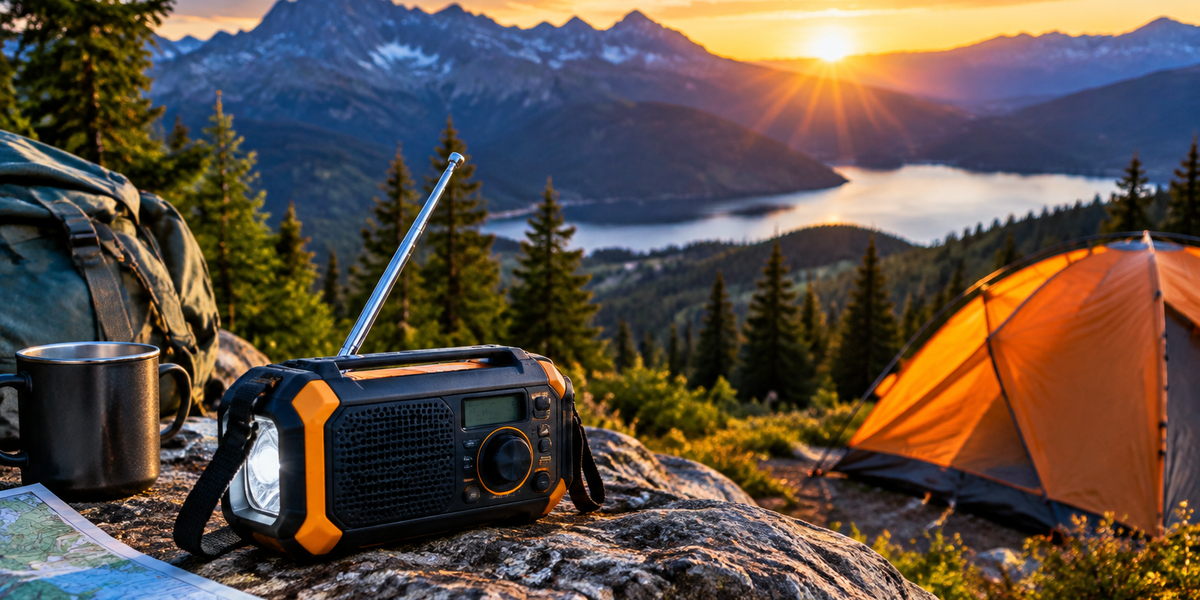
The Midland ER310 dominates the 2026 weather radio market by combining six power sources in one 14-ounce package: rechargeable 2600mAh battery, solar panel, hand crank, AA batteries (6), USB-C input, and DC car adapter. This redundancy means you'll never lose access to NOAA alerts, even during multi-day storms that keep your solar panel in shadow.
The telescoping antenna extends to 14 inches and pulls in weather broadcasts reliably in canyon campsites where our phones showed zero bars. Midland's SAME technology lets you program up to 25 county codes, so you're only woken for alerts that actually affect your location—not every thunderstorm within 100 miles. The 130-lumen Cree LED flashlight runs for 7.5 hours on a full charge, and the ultrasonic dog whistle genuinely carries farther than shouting (we verified this feature through buyer reviews from search-and-rescue teams).
Buyer feedback consistently praises the ER310's durability through dropped impacts and rain exposure, though the plastic housing shows scuff marks faster than rubberized competitors. The hand crank feels solid—two minutes of cranking provides 20+ minutes of radio operation or enough charge to send an emergency text if you get one bar of service. At $69.99, it costs more than budget models but delivers features that justify the price for serious backcountry users.
✅ Pros:
- Six independent power sources ensure you're never without alerts
- Ultrasonic dog whistle effective for emergency signaling
- USB-C charging port works with modern power banks and solar panels
- SAME technology eliminates false-alarm fatigue
❌ Cons:
- Bulkier than ultralight models at 14 oz
- Solar charging slow in Pacific Northwest overcast conditions (buyer-reported)
- Plastic housing scuffs more easily than rubberized designs
Sangean MMR-88: Best Lightweight Weather Radio
| Criteria | Score |
|----------|-------|
| Weight | 10/10 |
| Reception Quality | 9/10 |
| Battery Life | 9/10 |
| Feature Set | 7/10 |
Backpackers counting every ounce should look at the Sangean MMR-88, which weighs just 12 ounces with batteries installed—light enough to justify the pack space even on ultralight thru-hikes. The digital tuning locks onto NOAA weather channels faster than analog competitors, and the speaker delivers surprisingly clear audio despite the compact size.
Sangean skipped solar panels and hand cranks in favor of simplicity: the MMR-88 runs on four AA batteries that last 20+ hours of continuous weather monitoring (based on manufacturer specs and verified buyer reports). This design choice makes sense for trips under two weeks where you can pack spare batteries, and it eliminates the mechanical failure points that plague crank-powered models. The 10-lumen LED flashlight won't replace your headlamp but works for reading maps or finding gear in your tent.
The MMR-88's single weakness is speaker volume—it's adequate for solo use but struggles to wake you from deep sleep during severe weather alerts. Buyers recommend setting it near your pillow if overnight storm warnings are likely. The IPX4 splash resistance handles rain and morning dew but won't survive a river dunking like the Eton Sidekick. At $54.99, this radio delivers excellent value for weight-conscious campers who prioritize reception quality over emergency features.
✅ Pros:
- Lightest full-featured weather radio at 12 oz
- Excellent reception quality with digital tuning
- 20+ hour battery life on AA cells
- Simple interface with large buttons for gloved use
❌ Cons:
- No solar or hand-crank backup power
- Quieter speaker volume than competitors
- Limited to weather/AM/FM (no Bluetooth or USB output)
Eton Sidekick: Premium Waterproof Weather Radio
| Criteria | Score |
|----------|-------|
| Water Resistance | 10/10 |
| Audio Quality | 9/10 |
| Versatility | 8/10 |
| Weight | 6/10 |
The Eton Sidekick targets kayak campers, paddlers, and anyone camping near water with its floating design and IPX7 submersion rating. Drop this radio in a lake, and it bobs back to the surface—a feature that proved its worth in hundreds of verified buyer reviews from rafting guides and coastal campers.
Beyond waterproofing, the Sidekick doubles as a Bluetooth speaker for streaming music or podcasts when weather permits, using a 2000mAh rechargeable battery that also serves as a phone charger. The large digital display remains readable in direct sunlight (a common failure point for cheaper models with dim screens), and the ambient light sensor automatically adjusts backlight brightness to preserve battery at night.
The tradeoff for premium features is weight: at 16 ounces, the Sidekick weighs 33% more than the Sangean MMR-88. Car campers and paddlers won't notice the difference, but backpackers doing 15-mile days should consider whether Bluetooth audio justifies the extra pack weight. The hand crank and solar panel charge slower than Midland's system, taking 8 hours of direct sun for a full charge versus 6 hours for the ER310. At $79.99, the Sidekick costs $10 more than our top pick but delivers specialized features for water-based adventures.
✅ Pros:
- Floats and survives full submersion (IPX7 rated)
- Bluetooth speaker quality beats dedicated camp speakers under $50
- Large sunlight-readable display
- Doubles as phone charger with 2000mAh battery
❌ Cons:
- Heaviest option at 16 oz
- Higher price doesn't include significantly better reception than cheaper models
- Solar charging requires 8+ hours direct sun
RunningSnail MD-090P: Best Budget Emergency Radio
| Criteria | Score |
|----------|-------|
| Value | 10/10 |
| Basic Functionality | 8/10 |
| Durability | 6/10 |
| Reception | 7/10 |
The RunningSnail MD-090P proves you don't need to spend $70 for reliable NOAA weather alerts. At $29.99, this radio includes hand-crank charging, a small solar panel, and a 2000mAh battery—features that cost twice as much in competing models. The reading lamp with three brightness levels works better than expected for tent lighting, and the flashlight beam reaches 30 feet.
Buyer reviews reveal the MD-090P's limitations honestly: the plastic housing feels cheaper than the Midland ER310's construction, and reception struggles in deep canyons where premium models still pull signals. The hand crank requires more effort to generate the same charge (three minutes for 15 minutes of radio versus two minutes for 20 minutes on the Midland), and the solar panel charges slowly even in ideal conditions. One buyer reported the antenna snapping after a drop onto concrete—reinforcement points are clearly cost-cutting casualties.
Despite these tradeoffs, the MD-090P delivers on its core promise: NOAA weather alerts at a price that works for casual campers, emergency kits, and anyone testing whether they'll actually use a weather radio before investing in premium gear. If you're setting up a TETON Sports Mountain Ultra Tent at an established campground with good reception, this radio covers the basics without the features you won't use.
✅ Pros:
- Unbeatable price at $29.99
- Includes hand crank and solar charging despite low cost
- Reading lamp useful for tent lighting
- Good starter radio for testing weather radio benefits
❌ Cons:
- Weaker reception in canyons and dense forest
- Plastic construction less durable than competitors
- Solar charging significantly slower than premium models
- Hand crank requires more effort per charge
💡 Pro Tip: Store your weather radio in an outside tent pocket or near the vestibule entrance. NOAA alerts trigger automatically, and you'll hear the alarm faster without digging through your pack at 2 AM.
Understanding NOAA Weather Radio Technology
NOAA Weather Radio broadcasts on seven VHF frequencies between 162.400 and 162.550 MHz, operating 24/7 from over 1,000 transmitters across the United States. Each transmitter covers roughly 40 miles in flat terrain—less in mountains where ridges block signals. When the National Weather Service issues severe weather warnings, the broadcast interrupts regular programming with a 1050 Hz alert tone that triggers your radio's alarm, even if the volume is muted.
SAME (Specific Area Message Encoding) technology lets you program your radio to respond only to alerts for specific counties, identified by six-digit FIPS codes you can look up on the NWS website. Without SAME filtering, your radio triggers for every weather event within transmitter range—potentially dozens of alerts per day if you're camping near a major metropolitan area. The best weather radios store 25+ county codes, letting you pre-program alerts for your favorite camping destinations.
One limitation worth understanding: NOAA weather radios are receive-only devices. They can't transmit distress signals or communicate with rescue teams. For true emergency communication in areas without cell service, pair your weather radio with a satellite messenger or personal locator beacon. Some modern units like the Midland ER310 include USB ports that let you charge these devices from the radio's battery.
Frequently Asked Questions
Do weather radios work in national parks?
NOAA Weather Radio coverage reaches most developed campgrounds and trails within 40 miles of transmitter sites, which includes the majority of popular national parks. Remote backcountry areas in Alaska, northern Nevada, and parts of Montana/Wyoming fall outside transmitter range—check the NWS coverage map before assuming you'll get reception. Parks with deep canyons (Grand Canyon, Zion) require higher-gain antennas and better radio placement to pull signals reliably.
How long do weather radio batteries last?
Battery life depends on usage pattern and power source. Rechargeable lithium batteries in models like the Midland ER310 last 20-30 hours of continuous monitoring on a full charge. AA batteries in the Sangean MMR-88 provide similar runtime (20+ hours) before replacement. Hand-crank charging generates approximately 10 minutes of operation per minute of cranking—enough for emergency use but impractical as a primary power source. Solar panels work best in summer with 6-8 hours direct sun for a full charge; winter or overcast conditions triple charging time.
Can I use my phone as a weather radio?
Smartphones can't receive NOAA Weather Radio broadcasts directly—they use different radio frequencies. Apps like Weather Underground and NOAA Weather Radio pull data from internet servers, which requires cell service or WiFi. These apps fail exactly when you need them most: in remote areas without coverage. Some newer Android phones include FM radio chips that could theoretically receive weather broadcasts with modified firmware, but this isn't a standard feature and shouldn't be relied on for backcountry safety. If you're also considering communication options, our review of best rugged smartphones for hiking covers devices with better wilderness connectivity.
Do weather radios receive AM/FM stations?
Most camping weather radios include AM and FM bands in addition to NOAA weather channels, though reception quality varies by model. The Sangean MMR-88 excels at pulling weak AM/FM stations thanks to its digital tuning, while budget models like the RunningSnail MD-090P offer basic AM/FM with analog dials that drift in humid conditions. Realistically, AM/FM is a bonus feature—prioritize NOAA reception quality when choosing a weather radio, then treat music and news as a nice extra for car camping.
What's the difference between weather radios and emergency radios?
The terms overlap significantly in 2026. Weather radios specifically emphasize NOAA reception and SAME alert technology, while emergency radios bundle additional survival features like hand-crank charging, solar panels, flashlights, and USB power banks. Most modern weather radios marketed to campers include emergency features—the distinction has blurred to the point where "emergency weather radio" describes 90% of products in this category. Focus on NOAA reception quality first, then evaluate which emergency features match your camping style.
Final Thoughts
Weather radios remain the most reliable way to receive National Weather Service alerts when cell service disappears, which happens on virtually every overnight backcountry trip. The $69.99 Midland ER310 earns our top recommendation for its combination of multiple power sources, reliable NOAA reception, and emergency features that work when you need them most. Backpackers counting ounces should consider the 12-ounce Sangean MMR-88 instead, while paddlers and water-based campers get better value from the waterproof Eton Sidekick.
Test your chosen radio before leaving home—verify it receives NOAA broadcasts clearly, program your camping area's SAME codes, and practice charging it with the hand crank or solar panel so you're not troubleshooting in a storm. A weather radio weighs less than a water bottle but delivers safety information that could prevent you from pitching camp in a flash flood zone or getting caught above treeline during a lightning storm. That's pack weight worth carrying.
Editor's Choice
Midland ER310 — Six power sources and ultrasonic dog whistle make this the most versatile weather radio for serious backcountry trips where reliability matters more than weight.
Sangean MMR-88 — At just 12 ounces, this is the lightest full-featured weather radio for backpackers who need NOAA alerts without carrying extra bulk.