Disclosure: As an Amazon Associate, HikePod earns from qualifying purchases at no extra cost to you.
⭐ Our Top Pick
🏆 Best Overall: Adventure Medical Kits Ultralight Watertight .7 First Aid Kit — the lightest kit with genuine wound-care depth, so you're never caught unprepared on remote trails.
💰 Best Value: SOL Escape Lite Bivvy Emergency Sleeping Bag — at under $20 and 3.8 oz, it's the cheapest insurance policy against shock you can buy.
Introduction
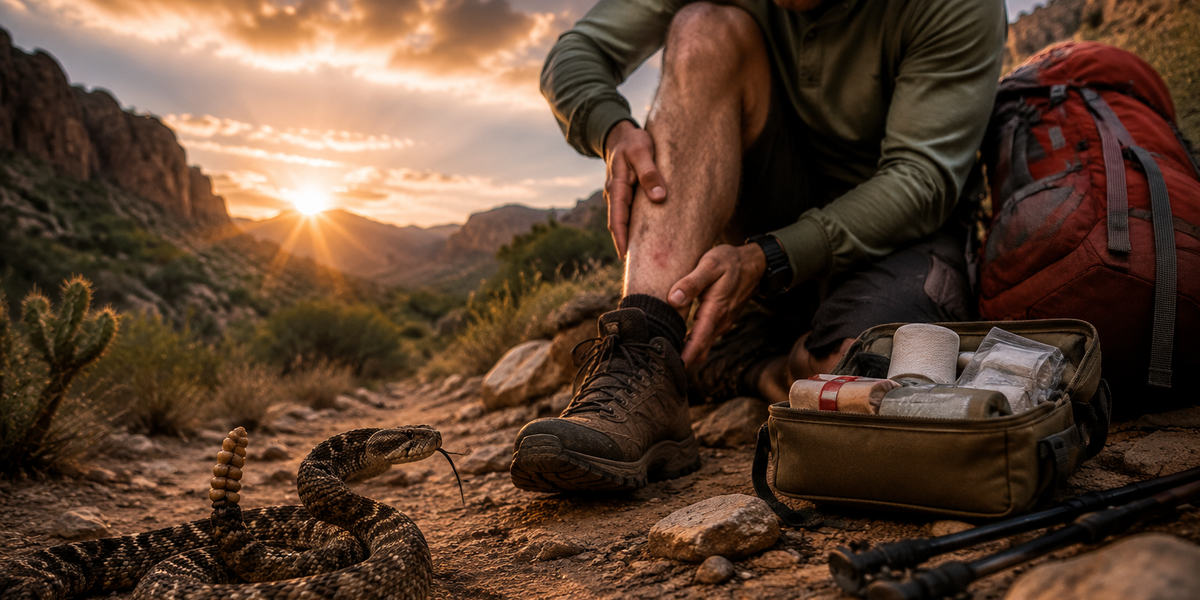
You're three miles from the trailhead when you hear it — that unmistakable dry rattle — and then a sharp sting on your ankle. Your heart hammers. What do you do?
Snake bites are rare, but they happen. In the United States alone, roughly 7,000 to 8,000 venomous snake bites are reported every year. Most victims survive, but outcomes depend heavily on what happens in the first 30 minutes — and the biggest danger isn't always the venom. It's the wave of well-meaning but dangerously wrong "first aid" instincts that can turn a manageable envenomation into a life-threatening crisis.
We've researched wilderness medicine protocols from the Wilderness Medical Society (WMS), the American Red Cross, and toxicology literature to bring you the most accurate, up-to-date guide for 2026. Bookmark this page before your next backcountry trip — and more importantly, share it with your hiking partners.
What to Look For in a Trail First Aid Kit for Snake Bite Preparedness
- Weight vs. capability balance: A kit you leave in the car because it's too heavy is useless. Aim for under 10 oz for day hikes, under 1 lb for multi-day trips.
- Wound care supplies: Clean bandages and antiseptic wipes help manage bite-site bleeding and reduce infection risk once you reach medical care.
- Immobilization materials: Rolled gauze, a triangular bandage, or even a Buff can serve as a soft splint or sling to keep the bitten limb still during evacuation.
- Emergency warmth: Shock is a real risk after envenomation. A compact emergency bivvy like the SOL Escape Lite Bivvy can maintain core temperature while you wait for help.
- Communication device: No first aid kit replaces a satellite communicator (PLB or InReach). Antivenin is the only real treatment — getting to a hospital fast is the mission.
- A written emergency plan: Know the nearest hospital with toxicology capability before you leave the trailhead. Screenshot it.
Trail First Aid Deep Dive
Step-by-Step: What to Do Immediately After a Snake Bite
| Response Criteria | Score |
|---|---|
| Speed of correct action | 10/10 |
| Difficulty without training | 6/10 |
| Impact on outcome | 10/10 |
| Gear required | 3/10 |
Step 1 — Move away from the snake. Back up calmly. A snake can strike again at up to two-thirds of its body length. Don't try to capture or kill it — emergency departments can identify species from a photo.
Step 2 — Call for help immediately. Dial 911 if you have signal. If not, activate your PLB or satellite messenger. Antivenin is only available at a hospital — this is the most important step.
Step 3 — Keep the victim calm and still. Anxiety and movement accelerate venom spread through the lymphatic system. Have the victim sit or lie down.
Step 4 — Immobilize the bitten limb at or below heart level. Use a soft sling or fold a Buff Original Multifunctional Headwear into a makeshift tie to keep the arm or leg still without cutting off circulation.
Step 5 — Remove constricting items. Rings, watches, and tight clothing near the bite site should come off before swelling begins.
Step 6 — Mark the time and monitor swelling. Use a pen to draw a circle around the edge of any swelling every 15 minutes. This gives paramedics critical progression data.
Step 7 — Treat for shock. Lay the victim flat, elevate their legs slightly (unless the bite is on the leg), and use the SOL Escape Lite Bivvy to retain body heat. Shock kills — don't skip this.
✅ Pros:
- These steps require zero special equipment
- Correct technique dramatically improves hospital outcomes
- Keeping the victim calm reduces venom dispersal
❌ Cons:
- Requires memorization before the emergency happens
- Distance from a trailhead significantly changes the evacuation calculus
---
What NOT to Do: Deadly Myths to Ignore in 2026
| Myth Danger Rating | Score |
|---|---|
| How widespread the myth is | 9/10 |
| Potential to cause direct harm | 10/10 |
| How convincing it sounds | 8/10 |
| Evidence against it | 10/10 |
❌ Do NOT suck out the venom. This is the most persistent myth in wilderness medicine. Oral suction is completely ineffective — venom enters the bloodstream within seconds — and it introduces bacteria from your mouth into the wound. Snakebite suction devices sold in older kits are no longer recommended by the WMS.
❌ Do NOT cut and drain the wound. Cutting causes additional tissue damage and increases infection risk. It does not remove meaningful amounts of venom.
❌ Do NOT apply a tourniquet. A tourniquet concentrates venom in a small area, causes ischemic tissue death, and can result in amputation. Do not do this.
❌ Do NOT apply ice. Cold compresses cause vasoconstriction that traps venom and dramatically worsens local tissue necrosis.
❌ Do NOT give the victim alcohol or medication (unless prescribed, like an EpiPen for anaphylaxis). Alcohol thins blood and masks symptoms.
❌ Do NOT let the victim walk out if avoidable. Carry them if you can, or have them move as slowly and calmly as possible.
💡 Pro Tip: Take a photo of the snake from a safe distance — or sketch it. Color, head shape, and rattle presence help toxicologists choose the right antivenin faster.
✅ Pros:
- Knowing what NOT to do is genuinely life-saving
- Avoids interventions that cause more harm than the bite itself
❌ Cons:
- Hard to override panic instincts without prior mental rehearsal
- Some myths are still taught in outdated first aid resources
---
Adventure Medical Kits Ultralight Watertight .7 — Trail First Aid Kit Review
| Criteria | Score |
|---|---|
| Weight & Packability | 10/10 |
| Wound Care Depth | 8/10 |
| Water Resistance | 9/10 |
| Value for Money | 9/10 |
The Adventure Medical Kits Ultralight Watertight .7 is our top recommendation for snake-bite-aware hikers because it hits the sweet spot between genuine capability and trail weight. At 7 oz with a DryFlex waterproof bag, it survives the creek crossings and afternoon thunderstorms that are most common in snake country. The kit includes wound closure strips, moleskin, elastic bandage, antiseptic wipes, and a guide to wilderness medicine — everything you need to stabilize a bite wound and manage secondary issues during evacuation. It won't replace a SAM splint or a satellite communicator, but no kit this light should be expected to.
✅ Pros:
- Watertight DryFlex bag — reliable in wet conditions where snakes are most active
- 7 oz total weight removes every excuse not to carry it
- Includes a wilderness medicine guide for reference under stress
❌ Cons:
- No SAM splint included — worth adding one separately for multi-day trips
- The moleskin pads, while useful, are a smaller complement to a dedicated blister kit
Frequently Asked Questions
How long do I have after a venomous snake bite?
There is no universal answer — it depends on the species, the amount of venom injected (about 25% of bites are "dry" with no venom), the victim's size and health, and the bite location. Generally, symptoms of significant envenomation appear within 30 minutes to 2 hours. That said, you should begin evacuation immediately, not wait to see how bad it gets.
Can I hike out after a snake bite?
Only if evacuation is otherwise impossible. Movement increases lymphatic spread of venom. The priority is to get rescuers to you, not to get yourself to the trailhead. Use your satellite communicator and stay put unless staying put poses a greater danger.
Are rattlesnake bites always venomous?
No. Roughly 20–25% of pit viper bites (rattlesnakes, copperheads, cottonmouths) are dry bites with no venom injected. However, you cannot tell this from appearance alone in the field. Always treat every bite as a potential envenomation and get to a hospital.
What's the best way to avoid snake bites on the trail?
Watch where you step and where you place your hands — especially when stepping over logs or reaching into rock crevices. Wear gaiters or high boots in brushy terrain. Stay on trail. In hot weather, snakes are most active at dawn, dusk, and night. Trekking poles help you probe ahead in low-visibility areas.
Does the Sawyer Extractor or any suction device work for snake bites?
No. The Wilderness Medical Society and major toxicology bodies stopped recommending suction devices years ago. Studies show they extract negligible venom while causing additional tissue damage. If you have one in an old kit, you can remove it.
Final Thoughts
A snake bite on the trail is a true wilderness emergency — but it's survivable with the right response. The core message is simple: stay calm, keep the victim still, immobilize the limb, call for evacuation, and don't do any of the dramatic things that movies suggest. Antivenin is the treatment. Your job is to get the victim to it as fast and safely as possible.
The best preparation is mental rehearsal before you ever hit the trail. Walk through these steps with your hiking group, make sure someone carries a reliable first aid kit, and have a communication plan. A 7 oz kit and a $20 bivvy might be the most important ounces in your pack.
Editor's Choice
Adventure Medical Kits Ultralight Watertight .7 First Aid Kit — the single most important piece of gear any snake-country hiker can carry, with real wound-care capability at a weight that leaves no excuses.
SOL Escape Lite Bivvy Emergency Sleeping Bag — an overlooked but critical tool for managing shock after envenomation, especially on remote trails where evacuation takes hours.
Buff Original Multifunctional UV Headwear — a surprisingly versatile piece of kit that every hiker already carries and can serve as an improvised sling or limb stabilizer in a pinch.