Disclosure: As an Amazon Associate, HikePod earns from qualifying purchases at no extra cost to you.
⭐ Our Top Pick
🏆 Best for Backpacking: Big Agnes Copper Spur HV UL2 — the perfect balance of ultralight performance and livable space for serious trail miles.
💰 Best Budget Entry: TETON Sports Mountain Ultra Tent — bridges car camping and backpacking without breaking the bank.
Introduction
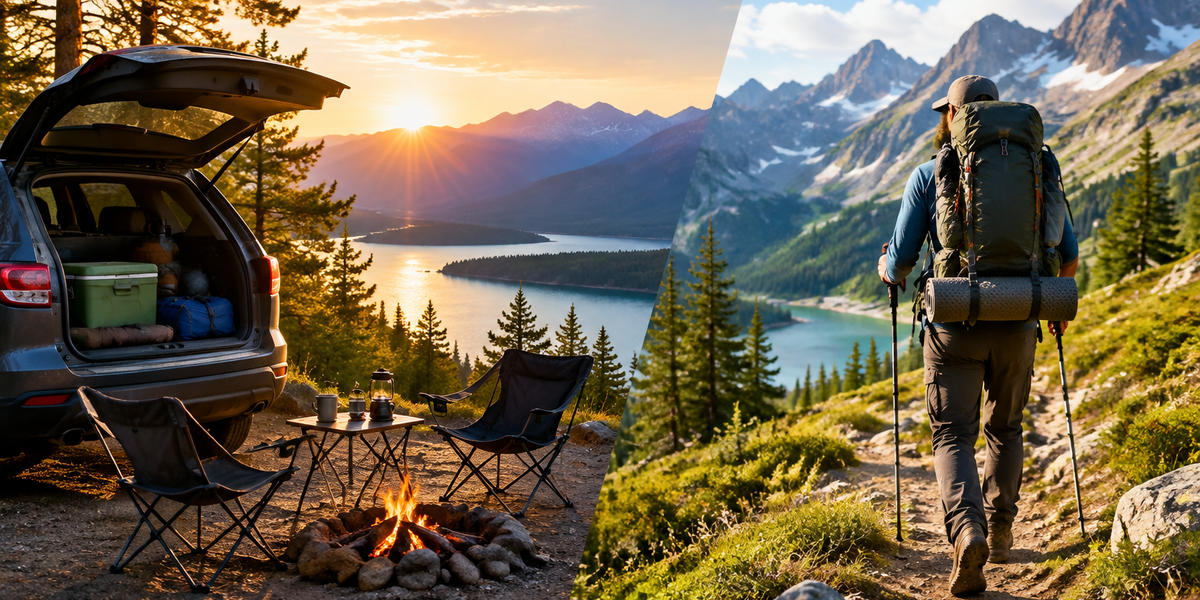
You're standing in your garage, staring at a pile of camping gear, and asking yourself: do I really need to carry all this on my back? The choice between car camping and backpacking isn't just about where you sleep—it's about the entire experience you're after. Car camping lets you bring the cooler, the camp chairs, and that cast-iron skillet. Backpacking strips everything down to what you can carry, trading creature comforts for remote solitude and the satisfaction of true self-sufficiency.
We've spent years comparing these two styles of camping across hundreds of trips, from crowded state park loops to alpine ridgelines 10 miles from the nearest road. After analyzing gear requirements, costs, skill curves, and the kinds of landscapes each style unlocks, we've built this guide to help you choose the approach that matches your goals, fitness level, and budget in 2026.
Whether you're a beginner trying to figure out where to start or an experienced camper considering a switch, we'll break down the real differences in gear investment, physical demands, trip planning, and the kind of wilderness access each style provides. By the end, you'll know which path fits your adventure style—and what gear you'll need to get started.
What to Look For
Weight and Portability — Car camping gear can weigh whatever it wants. Your tent can be 10 pounds, your sleeping bag a fluffy 4-pounder, and your stove a two-burner propane setup. Backpacking flips this entirely: every ounce counts when you're carrying everything on your shoulders. A backpacking tent needs to weigh under 3 pounds, your sleeping bag should compress to the size of a football, and your stove might be a titanium canister burner that weighs 3 ounces. If you're not willing to scrutinize weight on every piece of gear, car camping is the more forgiving choice.
Gear Investment — Car camping gear is cheaper upfront. You can outfit a weekend trip for under $300 with a basic tent, synthetic sleeping bag, and a Coleman stove. Backpacking demands lighter, more technical gear—expect to spend $800–$1,500 for a quality ultralight tent, down sleeping bag, backpacking stove, and a comfortable pack like the Osprey Atmos AG 65 that won't destroy your shoulders after mile five. The price gap is real, and it reflects the engineering required to make gear both lightweight and durable.
Physical Fitness Requirements — Car camping is accessible to almost everyone. You walk 50 feet from your vehicle, set up camp, and relax. Backpacking requires cardiovascular fitness, joint stability, and core strength to carry 25–40 pounds for miles on uneven terrain. If you're recovering from an injury, new to fitness, or camping with young kids or older family members, car camping removes the physical barrier. Backpacking rewards fitness but demands it as table stakes.
Wilderness Access — This is where backpacking wins decisively. Car camping confines you to designated campgrounds with road access—usually developed sites with bathrooms, fire rings, and neighbors 20 feet away. Backpacking opens up the backcountry: alpine lakes, ridgeline campsites, slot canyons, and places where you won't see another human for days. If solitude and untouched landscapes are your priority, backpacking is the only way to reach them. If you're after convenience and don't mind some company, car camping keeps you comfortable. For tips on selecting the perfect spot once you arrive, see our How to Choose a Campsite: What to Look for Before You Pitch Your Tent guide.
Trip Planning Complexity — Car camping is plug-and-play: reserve a site online, pack your cooler, and drive there. Backpacking requires permits, route planning, water source mapping, bear canister regulations, and Leave No Trace skills. You need to know how to hang a bear bag, filter water, navigate with a map, and handle emergencies miles from help. The learning curve is steeper, but the reward is self-reliance and the ability to go anywhere your legs will take you.
Social vs. Solo Experience — Car camping is inherently social. Campgrounds foster community—you'll hear guitar strumming from the next site, smell someone's campfire bacon, and chat with neighbors over morning coffee. It's ideal for group trips, family reunions, or introducing friends to the outdoors. Backpacking leans solitary or small-group. You control your environment, move at your own pace, and experience wilderness without the soundtrack of RVs and generators. If you crave quiet and introspection, backpacking delivers. If you want a shared outdoor experience with minimal logistics, car camping is the move.
Big Agnes Copper Spur HV UL2 Backpacking Tent
| Criteria | Score |
|----------|-------|
| Weight | 10/10 |
| Livable Space | 9/10 |
| Weather Protection | 8/10 |
| Value | 7/10 |
The Big Agnes Copper Spur HV UL2 is the tent we recommend most often for serious backpackers who refuse to choose between weight and comfort. At 2 pounds 10 ounces trail weight, it's light enough for thru-hikers but roomy enough for two people to sit up and play cards during a rainstorm. The two-door, two-vestibule design means no one has to crawl over their partner at 2 AM, and the color-coded setup makes solo pitching genuinely fast—we've clocked sub-5-minute setups after a long day on the trail. The high-volume pole architecture maximizes headroom without adding weight, and the pre-cut guylines and reflective points make nighttime adjustments easy. Weather resistance is strong in moderate conditions, though heavy sustained rain can create some condensation on the single-wall fly. For the weight, though, this tent offers more livable space than anything else in its class.
✅ Pros:
- Ultra-light 2.6 lbs packed weight for two-person capacity
- Two doors and vestibules eliminate the crawl-over problem
- Sets up solo in under 5 minutes with color-coded poles
❌ Cons:
- Premium price point ($549.95) is a barrier for beginners
- Single-wall fly creates condensation in humid conditions
MSR Hubba Hubba NX 2 Backpacking Tent
| Criteria | Score |
|----------|-------|
| Weight | 9/10 |
| Weather Protection | 10/10 |
| Packability | 9/10 |
| Value | 8/10 |
The MSR Hubba Hubba NX 2 is the tent we grab when the forecast calls for weather. Its freestanding design means you can pitch it on rock slabs or sandy beaches without hunting for stake-able ground, and the full-coverage rainfly with reinforced stress points has kept us dry through some genuinely brutal overnight storms. At 3 pounds 7 ounces minimum weight (20 ounces per person when split between partners), it's not the lightest option, but the tradeoff is bombproof construction and a reputation for lasting seasons. The easton syclone poles flex under wind load without breaking, and the unified pole structure makes setup intuitive even in the dark. Vestibule space is tighter than the Copper Spur, so expect to Tetris your boots and pack a bit, but the interior feels spacious thanks to nearly vertical walls. If you prioritize storm performance and long-term durability over absolute minimum weight, this is the tent.
✅ Pros:
- Freestanding design sets up anywhere without staking
- Excellent rain performance with reinforced fly attachment points
- Packs down to 20 oz per person when split between partners
❌ Cons:
- Smaller vestibules than the Copper Spur require tighter gear organization
- Floor footprint requires precision staking for optimal tension
TETON Sports Mountain Ultra Tent
| Criteria | Score |
|----------|-------|
| Value | 10/10 |
| Weather Protection | 7/10 |
| Weight | 5/10 |
| Durability | 6/10 |
The TETON Sports Mountain Ultra Tent is the bridge tent—not quite light enough for serious backpacking, but portable enough to carry on short overnight trips if you're not ready to invest $500 in an ultralight shelter. At $89.99, it's the entry point for campers transitioning from car camping to trail camping, and it does that job well. The full-coverage fly keeps you dry in moderate rain, and the vestibule provides enough space for boots and a small pack. At 5+ pounds, you'll feel the weight on anything longer than a 3-mile approach, but for weekend warriors testing the backpacking waters or families doing short hikes to backcountry sites, the price-to-performance ratio is solid. The poles lack the sophisticated alloys of premium tents and can bend under heavy wind, so this isn't your alpine expedition shelter—but for summer camping below treeline, it's a dependable budget option that won't leave you soaked or broke.
✅ Pros:
- Budget-friendly entry point at under $90
- Full fly coverage protects in rain without complicated setup
- Good ventilation for summer camping in humid conditions
❌ Cons:
- Heavier at 5+ lbs—too much for long backpacking trips
- Poles lack the durability of premium tents under sustained wind load
💡 Pro Tip: If you're new to backpacking, start with a single overnight trip close to the trailhead. Test your gear, assess your fitness, and learn your packing rhythm before committing to multi-day expeditions.
Osprey Atmos AG 65 Backpacking Pack
| Criteria | Score |
|----------|-------|
| Comfort | 10/10 |
| Load Distribution | 10/10 |
| Capacity | 9/10 |
| Weight | 6/10 |
The Osprey Atmos AG 65 redefines what a loaded pack should feel like on your back. The Anti-Gravity suspension system uses a tensioned mesh panel that creates a gap between your back and the pack body, distributing weight across your hips and shoulders while allowing continuous airflow. After 10 miles with 35 pounds on your back, this design makes the difference between arriving at camp tired or arriving destroyed. The 65-liter capacity handles 4–5 day trips comfortably, with enough room for bear canisters, extra layers, and a fuel canister without playing Tetris. The integrated rain cover deploys in seconds, the hydration sleeve fits 3-liter reservoirs, and the hip belt pockets keep snacks and your phone accessible without stopping. At 4.5 pounds, it's heavier than frameless ultralight packs, but if you're carrying substantial weight—camp chairs, photography gear, or winter insulation—the Atmos carries it better than anything else we've tested. For weekend trips under 20 pounds, you can find lighter options. For extended trips where comfort matters more than ounce-counting, this pack is unmatched.
✅ Pros:
- Anti-Gravity suspension floats weight off your back with tensioned mesh
- Best-in-class comfort for multi-day trips with heavy loads
- Integrated rain cover and hydration sleeve with thoughtful pocket placement
❌ Cons:
- Overkill capacity for weekend trips—consider the 50L version instead
- Heavier at 4.5 lbs than frameless ultralight packs for minimalists
Frequently Asked Questions
Can I use car camping gear for backpacking?
You can, but you'll suffer. A car camping tent weighs 8–12 pounds; a backpacking tent weighs 2–4 pounds. That 6–8 pound difference adds up fast when you're also carrying water, food, and a sleeping bag. Car camping sleeping bags are bulkier and heavier, and car camping stoves require propane canisters that weigh a pound each. If you're planning even occasional backpacking trips, invest in dedicated lightweight gear from the start. Trying to backpack with car camping gear will either limit your range to a mile from the car or leave you miserable on the trail.
How much does it cost to get started with each style?
Car camping: $300–$500 for a basic tent, sleeping bag, stove, cooler, and chairs. You can often borrow or buy used gear without much risk. Backpacking: $800–$1,500 for a lightweight tent, down sleeping bag, backpacking pack, stove, water filter, and sleeping pad. The higher cost reflects the technical requirements—every piece of gear must be light, compact, and durable. If budget is tight, start with car camping and transition to backpacking as you save or find deals on used gear from thru-hikers selling their setups.
Which style is better for families with kids?
Car camping wins for families with young kids (under 10). You can bring bulk snacks, extra clothes, games, and comfort items without weight penalties. Kids can run around a campground, use bathrooms, and retreat to the car if weather turns bad. Backpacking with kids requires they carry their own gear (doable around age 8–10) or you carry extra weight, and it limits your daily mileage to 3–5 miles. Once kids hit their teens with decent fitness, backpacking becomes feasible and teaches self-reliance. Until then, car camping keeps the experience positive without the physical grind.
Do I need permits for car camping and backpacking?
Car camping usually requires campground reservations (recreation.gov, state park systems) but rarely needs permits beyond your site reservation. Backpacking often requires wilderness permits, especially in popular areas like national parks, and some zones have daily quotas that fill months in advance. You'll also need to follow Leave No Trace principles, pack out all waste, and sometimes carry bear canisters. The permit system protects wilderness areas from overuse, but it adds a planning layer that car camping skips. Check specific regulations for your destination well before your trip.
Can I transition from car camping to backpacking gradually?
Absolutely—start with short overnight backpacking trips (2–3 miles in) to test your gear and fitness without committing to a multi-day expedition. Choose trails with car-camping-style amenities nearby (pit toilets, established campsites) to ease the transition. Upgrade your gear one piece at a time: start with a lighter tent, then a better sleeping bag, then a proper backpacking pack. Many backpackers we know started as car campers and made the switch over a season or two as their confidence and gear collection grew. There's no rule that says you have to choose one style forever—plenty of people do both depending on the trip.
Final Thoughts
The choice between car camping and backpacking comes down to what you value most: convenience and comfort, or solitude and self-sufficiency. Car camping is the accessible on-ramp to outdoor recreation—lower cost, easier logistics, and a social atmosphere that makes it ideal for beginners, families, and anyone who wants to enjoy nature without the physical demands of carrying everything on their back. Backpacking is the deep end: higher upfront costs, serious fitness requirements, and a steeper learning curve, but it unlocks landscapes and experiences that car camping can never reach.
We recommend starting with car camping if you're new to the outdoors, then experimenting with short backpacking trips once you've dialed in your basic camping skills. If you know you want remote wilderness access and are willing to invest in lightweight gear and build your fitness, jump straight into backpacking with quality gear that won't fight you on the trail. Both styles have a place in a well-rounded outdoor life—we still car camp for social trips and backpack when we need to disappear into the mountains for a reset.
Whichever path you choose, start this season. The best camping style is the one that gets you outside consistently, whether that's a state park loop 30 minutes from home or a ridgeline campsite three days into the backcountry.
Editor's Choice
Big Agnes Copper Spur HV UL2 Backpacking Tent — The gold standard for ultralight backpacking with comfort features you'd expect from heavier tents.
Osprey Atmos AG 65 Backpacking Pack — The most comfortable way to carry a heavy load on extended backpacking trips.
TETON Sports Mountain Ultra Tent — Bridges car camping and backpacking without breaking the bank for first-timers testing the waters.