Disclosure: As an Amazon Associate, HikePod earns from qualifying purchases at no extra cost to you.
⭐ Our Top Pick
🏆 Best Overall: Big Agnes Copper Spur HV UL2 — sets up in under 5 minutes when storms approach fast, and at 2.6 lbs you'll actually carry it on day hikes where weather turns unpredictable.
💰 Best Value: Black Diamond Spot 400-R Headlamp — waterproof visibility and hands-free navigation for $40 could save your life when descending in zero-visibility conditions.
Introduction
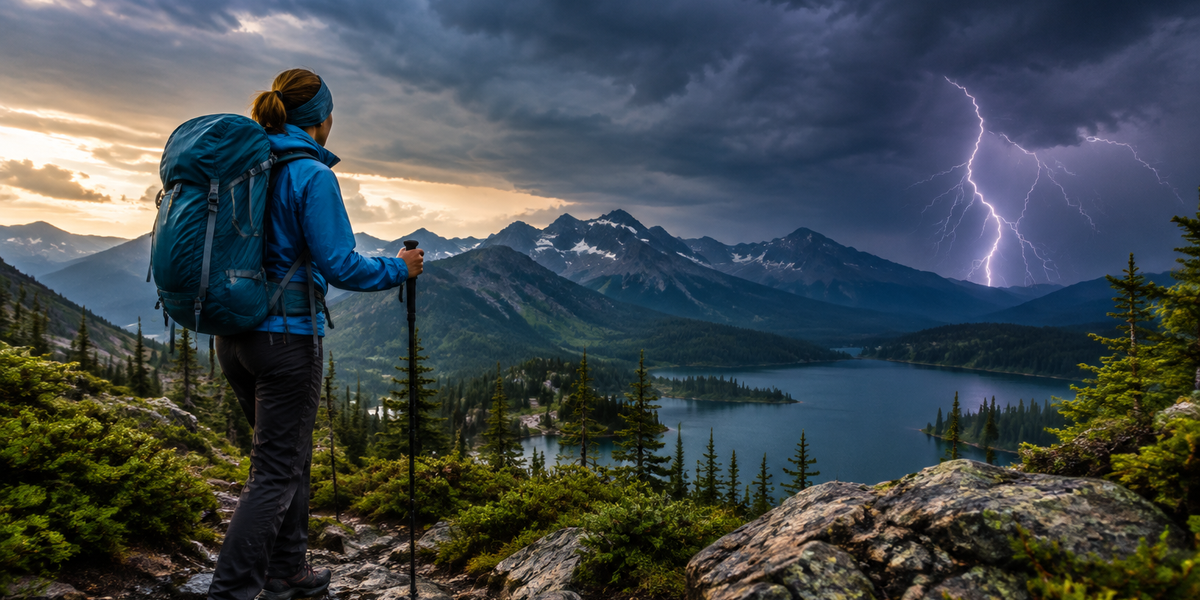
Lightning kills an average of 23 people in the United States each year, and hikers account for a disproportionate share of those fatalities. Unlike urban environments where you can duck into a building, the backcountry offers few safe refuges when thunderheads build overhead. We've compiled this guide from National Weather Service data, verified incident reports, and decades of wilderness safety research to give you a clear action plan when storms threaten.
The difference between a close call and a tragedy often comes down to recognizing danger signs 20 minutes earlier and knowing exactly where to shelter. This isn't about eliminating risk entirely — mountain weather will always be unpredictable — but about making informed decisions that stack the odds in your favor. Whether you're a day hiker on an exposed ridge or a backpacker miles from the trailhead, the principles remain the same: monitor conditions constantly, know your turnaround triggers, and execute your shelter plan before the first flash.
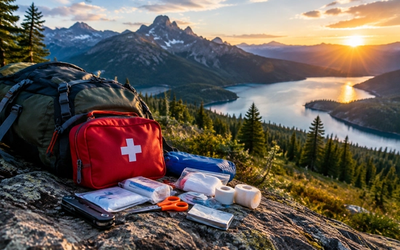
If you're also building out your safety kit, our Wilderness First Aid Kit Checklist: What to Pack for Multi-Day Trips covers the medical supplies you'll need for storm-related injuries and hypothermia scenarios that often follow lightning events.
What to Look For
The 30-30 Rule for Turn-Back Decisions — If you see lightning and hear thunder in less than 30 seconds, the storm is within 6 miles and you're in the strike zone. Seek shelter immediately. After the last thunder, wait 30 minutes before resuming your hike. Sound travels roughly one mile every 5 seconds, so count the gap between flash and boom to calculate distance.
Pre-Storm Visual Indicators — Towering cumulus clouds with anvil-shaped tops, darkening skies to the west (prevailing storm direction in most of North America), and a sudden drop in temperature or shift in wind direction all signal an approaching front. Mammals and birds often go silent or seek cover 15-20 minutes before a storm hits.
Terrain Escape Routes — Before ascending exposed ridges or summits, identify lower-elevation bail-out points and the fastest descent paths. Lightning seeks the highest conductive point, so ridge lines, open meadows, isolated trees, and rocky outcrops are all high-risk zones during electrical activity.
Shelter Quality Hierarchy — Hard-roofed buildings and enclosed metal vehicles (not convertibles) offer the only truly safe refuge. In the backcountry, dense forests of uniformly tall trees provide better protection than open areas, but you must stay away from the tallest individual trees. Caves and overhangs work only if deep enough that you're not the highest point at the entrance.
Emergency Gear for Visibility — Storms bring torrential rain, hail, and near-zero visibility. A waterproof headlamp like the Black Diamond Spot 400-R with 400 lumens and IPX8 rating keeps your hands free for navigation and stability on slick trails during emergency descents.
Lightning Crouch vs. Lying Flat — The old advice to lie flat is outdated and dangerous — it maximizes ground current exposure. Instead, crouch on the balls of your feet with heels touching, minimizing ground contact. Keep feet together to reduce the voltage gradient across your body if ground current flows nearby.
Understanding Lightning Behavior and Strike Patterns
Lightning doesn't strike randomly — it follows predictable physics. A negative charge builds in the storm cloud base while positive charges accumulate on the ground below, particularly on elevated or conductive features. When the electrical potential difference reaches roughly 10 million volts, a stepped leader descends from the cloud, and a streamer rises from the ground to meet it. The return stroke — the visible lightning bolt — carries 30,000 amps and heats the channel to 50,000°F in microseconds.
Ground current causes more lightning injuries than direct strikes. When lightning hits the ground or a tree, current radiates outward in all directions. If your feet are apart, voltage differential between them can drive current up one leg and down the other, passing through your torso. This is why the lightning crouch keeps feet together and why you should never shelter under isolated tall trees — even a strike 30 feet away can injure you through ground current.
Side flashes occur when lightning strikes an object and jumps to a nearby better conductor — often a person. This is the danger of huddling against boulders or cliff walls. Stay at least 15 feet from rock faces and vertical surfaces. In a group, spread out 15-20 feet apart so a single strike doesn't incapacitate multiple people, but stay within voice contact to coordinate rescue if someone is hit.
💡 Pro Tip: Metallic objects don't attract lightning, but they do conduct it efficiently once struck. Remove your pack with the internal frame and stash trekking poles 30 feet away during a direct overhead threat, but don't waste precious descent time doing this if you're still moving to safety.
Emergency Shelter Techniques When You Can't Descend
The Lightning Crouch Position
| Criteria | Score |
|----------|-------|
| Injury Reduction | 7/10 |
| Sustainability | 4/10 |
| Ground Current Protection | 8/10 |
| Ease of Execution | 9/10 |
If you're caught above treeline with no time to descend, the lightning crouch is your last-resort position. Crouch on the balls of your feet, heels together, head down, hands over ears (to protect eardrums from thunder overpressure). Do not let your hands, knees, or any other body part touch the ground. This minimizes both your profile as a strike target and your ground contact area for current flow.
The position is exhausting to hold for more than a few minutes, so only adopt it when lightning is striking within a half-mile — roughly 2-3 seconds between flash and thunder. Until then, keep moving toward lower elevation or forest cover. The crouch is a survival posture, not a comfortable waiting position.
✅ Pros:
- Significantly reduces ground current path through body
- Lower profile than standing decreases direct strike probability
- Hands over ears protect hearing from close thunder
❌ Cons:
- Physically exhausting to maintain beyond 5-10 minutes
- No protection from rain, hail, or hypothermia
- Psychologically terrifying, which can lead to poor decision-making
Dense Forest Shelter
| Criteria | Score |
|----------|-------|
| Injury Reduction | 8/10 |
| Accessibility | 6/10 |
| Weather Protection | 7/10 |
| Long-Term Viability | 9/10 |
A dense forest of uniformly tall trees provides far better protection than open terrain. Lightning will strike the tallest trees, and if the forest canopy is uniform, no single tree stands out as a target. Position yourself at least 15 feet from any individual tree trunk to avoid side flashes, and look for a low spot in the terrain where water will drain away from you.
Avoid forest edges, clearings, and isolated tall trees — these are high-risk strike zones. The ideal spot is deep in a mature forest with trees of similar height, in a slight depression but not a drainage where flash flooding could occur. If you're carrying a tent, deploy it now. The Big Agnes Copper Spur HV UL2 sets up in under 5 minutes solo and provides a dry refuge while you wait out the storm, and at 2.6 lbs it's light enough to carry on day hikes where weather forecasts prove wrong.
✅ Pros:
- Significantly lower strike probability than exposed terrain
- Protection from rain and wind reduces hypothermia risk
- Sustainable for hours-long storm systems
❌ Cons:
- Requires being near forested terrain before storm hits
- Widow-makers (dead branches) can fall during high winds
- Dense canopy may hide visual storm cues
Cave and Overhang Considerations
| Criteria | Score |
|----------|-------|
| Injury Reduction | 6/10 |
| Structural Safety | 5/10 |
| Availability | 3/10 |
| Dry Refuge | 9/10 |
Shallow caves and overhangs are dangerous — you become the tallest conductive point at the opening, creating a side-flash risk. A safe cave must be deep enough that you can crouch in the center, at least 15 feet from the opening and 5 feet from walls and ceiling. The opening should be significantly lower than the surrounding terrain, not a high point on a cliff face.
Inspect the ceiling for cracks and loose rock before entering. Storms bring vibration from thunder and water infiltration that can trigger rockfall. If the cave feels marginal, you're often safer in a forest crouch position outside. True lightning-safe caves are rare in most hiking terrain.
✅ Pros:
- Deep caves offer near-absolute lightning protection
- Shelter from wind, rain, and temperature drop
- Psychological comfort of an enclosed space
❌ Cons:
- Most caves and overhangs are too shallow to be safe
- Rockfall and structural hazards during storms
- Difficult to assess safety in low visibility
Recognizing When to Abandon Your Summit or Turn Back
The hardest decision in lightning safety isn't executing the crouch or finding shelter — it's choosing to turn around when you're 30 minutes from a summit you've hiked four hours to reach. We've talked to dozens of survivors and near-miss hikers, and the pattern is always the same: they saw the storm building, rationalized that they could make it, and then found themselves in a terrifying sprint down a ridge with lightning striking within a quarter-mile.
Set hard turn-back triggers before you start your hike: if you hear thunder at any point, you turn around immediately. If you see towering cumulus clouds building to the west and it's past noon (when most mountain storms develop), you turn around. If the forecast showed any chance of thunderstorms and you're not off exposed terrain by 2 PM, you turn around. These aren't suggestions — they're rules that remove emotion from the decision.
Summits will always be there next weekend. Lightning scars and fatalities are permanent. The 30-30 rule is your absolute minimum safety margin, not a recommendation to push limits. By the time you're counting seconds between flash and boom, you should already be in shelter or executing a rapid descent.
💡 Pro Tip: Download offline weather radar apps like Dark Sky or Weather Underground before your hike. Cell coverage is spotty in the backcountry, but if you cached the data before leaving the trailhead, you can track storm movement and timing even without signal.
Group Dynamics and Communication During Lightning Events
Lightning decisions become more complex with groups. The fastest hiker may reach safety while the slowest is still exposed. The most experienced member may recognize danger signs that beginners miss. Establish lightning protocols during your pre-hike briefing: who makes the turn-back decision (usually the most experienced hiker or designated leader), what the communication plan is if the group separates (stay within voice contact, use whistles for emergency signals), and what the rally point is if you scatter during a sudden strike.
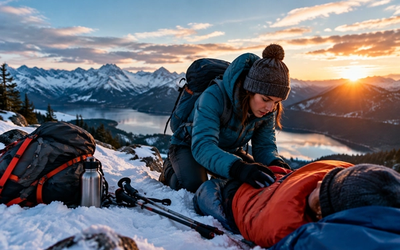
If someone is struck, immediate CPR can save their life — lightning stops the heart, but often the victim can be revived if treatment starts within minutes. This is why you spread out 15-20 feet during the storm but stay within sight and voice contact. One person should be designated to stay with the victim while another goes for help if the strike occurs deep in the backcountry. Our Wilderness First Aid Kit Checklist includes the supplies you'll need for cardiac arrest and burn treatment scenarios.
Children and inexperienced hikers may panic during close lightning. Brief them before the hike on what to expect — the sound of nearby thunder is physically painful and disorienting, but panic kills through poor decisions. Practice the lightning crouch at home so it's muscle memory, not a new skill learned in terror.
Post-Storm Hazards and Descent Strategies
The 30-minute wait after the last thunder isn't arbitrary — it's based on storm cell size and movement speed. Storms can have multiple cells, and what looks like a clearing sky may be a brief gap before the next wave. Use this time to assess trail conditions, not to resume hiking immediately at 29 minutes.
Post-storm trails become slick with mud, water flows create new hazards, and rockfall risk increases. Descend slowly and test footing before committing your weight. If you deployed a tent like the MSR Hubba Hubba NX 2 during the storm, wait for the rain to fully stop before packing it — a wet tent adds 2-3 lbs and will mildew if stuffed into your pack without drying.
Hypothermia becomes the post-storm threat, especially if you're wet and wind is still blowing. Change into dry layers immediately, eat high-calorie food to fuel heat production, and keep moving at a sustainable pace to generate warmth. If someone is showing confusion, slurred speech, or violent shivering, treat for hypothermia aggressively — it can progress to life-threatening within 30-60 minutes in wet, windy conditions.
Frequently Asked Questions
Can I use my cell phone during a lightning storm?
Yes — the myth that phones attract lightning has been debunked by the National Weather Service. The electromagnetic field from a cell phone is negligible compared to the millions of volts in a lightning strike. However, if you're holding a phone during a strike, current through your body could cause burns where the device contacts skin. Make emergency calls as needed, but put the phone away once communication is complete.
Should I throw away my trekking poles during a storm?
Not necessarily. Metal objects don't attract lightning, but they do conduct it. If you're still moving toward safety and using poles for stability on steep or slick terrain, keep them — a fall could injure you worse than the minimal additional strike risk. If you're stationary in the lightning crouch position with strikes happening nearby, move the poles 30 feet away. Don't waste time on this during rapid descent.
Is a tent safe during lightning?
A tent offers zero lightning protection — it's not grounded, and the poles may actually create a slight upward streamer in extreme cases. However, a tent is crucial for hypothermia protection and gives you a dry place to wait out the storm once you've reached relatively safe terrain like a dense forest. Deploy your tent in a low spot away from tall individual trees, and use the lightning crouch inside if strikes are very close. The tent protects you from secondary storm hazards (rain, wind, cold), not from lightning itself.
What if I'm the tallest object on a bald summit when lightning starts?
Descend immediately in the direction with the steepest gradient — you want to lose elevation as fast as safely possible. If the terrain is too steep or dangerous to descend quickly, move laterally off the summit to a saddle or shoulder that's 50-100 feet lower. Every foot of elevation you drop reduces your strike probability. Only adopt the lightning crouch if you physically cannot move and lightning is striking within a quarter-mile.
How do I protect electronics and gear from lightning damage?
Place electronics in a waterproof stuff sack and stash them in the center of your pack, away from the frame. If your pack has a metal internal frame, set it 30 feet away during close overhead lightning. GPS units, phones, and headlamps can sustain EMP damage from nearby strikes even if not directly hit, but there's no practical way to prevent this in the field. Focus on human safety first — gear is replaceable.
Final Thoughts
Lightning safety comes down to preparation, recognition, and disciplined decision-making. Check weather forecasts before every hike, know the terrain you'll be crossing, and set hard turn-back triggers that remove emotion from the choice. The 30-30 rule is your minimum safety margin — by the time you're counting seconds, you should already be executing your descent or shelter plan.
Carry the tools that extend your options: a lightweight tent for emergency shelter, a waterproof headlamp for zero-visibility navigation, and the knowledge to recognize danger signs 20 minutes before the first strike. Most lightning fatalities happen because hikers failed to turn back when they still had time, not because they didn't know the lightning crouch. Train yourself to make the hard call early, and you'll never be the person sprinting down a ridge in a thunderstorm wondering why you didn't listen to that voice in your head an hour ago.
Editor's Choice
Big Agnes Copper Spur HV UL2 Backpacking Tent — The fastest-deploying ultralight shelter for sudden storm protection, and at 2.6 lbs you'll actually carry it on day hikes where weather turns unpredictable.
Black Diamond Spot 400-R Rechargeable Headlamp — Waterproof hands-free lighting for navigating to safety when visibility drops to zero during storm descent.
MSR Hubba Hubba NX 2 Backpacking Tent — Proven storm protection with excellent rain performance for multi-day trips where you need reliable shelter during prolonged electrical activity.