Disclosure: As an Amazon Associate, HikePod earns from qualifying purchases at no extra cost to you.
⭐ Our Top Pick
🏆 Best Safety Tool: Black Diamond Spot 400-R Rechargeable Headlamp — 400 lumens of visibility prevents encounters during the dawn and dusk hours when mountain lions hunt most actively.
Introduction
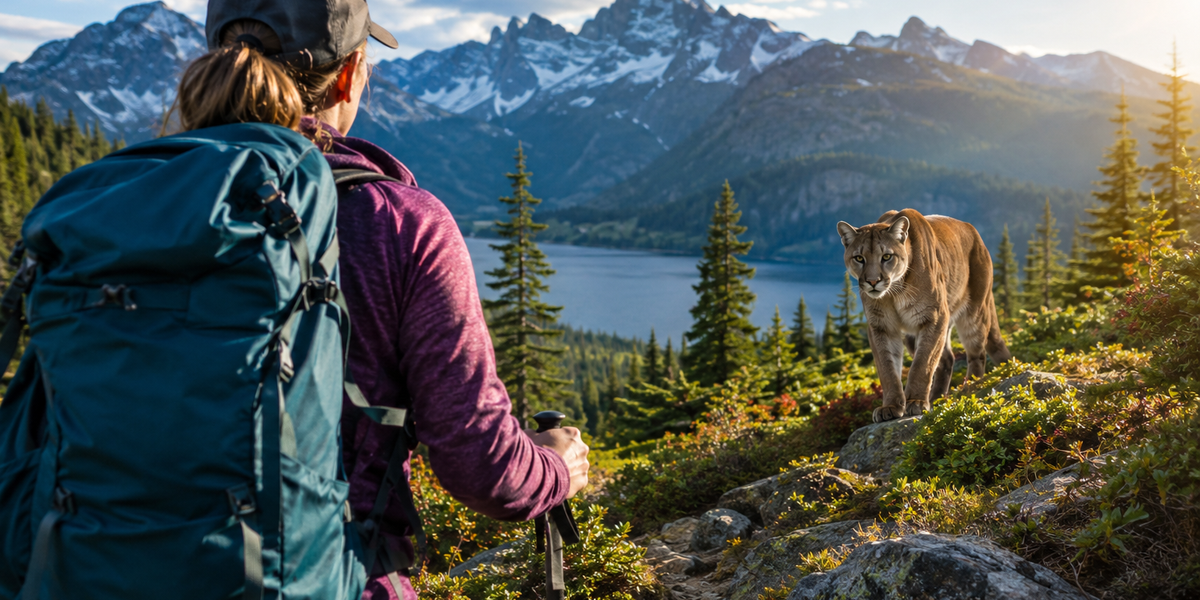
You're two miles into a remote trail when movement catches your eye—a tawny shape 50 yards ahead, unmistakably feline and far too large to be a bobcat. Your pulse spikes. Mountain lion encounters are rare (hikers have roughly a 1-in-25-million chance of being attacked), but when they happen, your response in the next 60 seconds matters enormously.
We've compiled this guide from wildlife behavior research, verified incident reports from state wildlife agencies, and field protocols used by backcountry professionals. Mountain lions (also called cougars or pumas) are ambush predators that rely on stealth and the element of surprise. Understanding their behavior and having a clear action plan transforms a potentially dangerous situation into one you can navigate safely.
This isn't about fear—it's about preparedness. After comparing documented encounters across California, Colorado, and Washington state databases, we've identified the response patterns that consistently lead to safe outcomes. Here's exactly what to do.
What to Look For in Mountain Lion Country
Before we cover encounter protocol, recognize the environmental cues that indicate you're in active cougar habitat:
Recent Sign and Activity Markers — Fresh tracks (3-4 inches wide with no claw marks), scat with hair and bone fragments, or scratch marks on trees signal recent activity. Wildlife agencies recommend increased vigilance when you spot these indicators.
Terrain and Vegetation — Mountain lions favor areas with cover for stalking: dense brush, rocky outcroppings, and terrain transitions where forests meet meadows. They hunt where deer congregate, so prime deer habitat equals prime cougar habitat.
Time of Day Considerations — Cougars are crepuscular hunters, most active at dawn and dusk. Starting your hike after sunrise and finishing before sunset dramatically reduces encounter probability. If you must hike during low-light hours, a reliable headlamp like the Black Diamond Spot 400-R provides 400 lumens of visibility that makes you detectable to wildlife from greater distances.
Deer Behavior — If deer appear agitated, bolt suddenly without apparent cause, or you find fresh kill sites (partially buried carcasses), a mountain lion is likely nearby and may be territorial about the food source.
Solo vs. Group Dynamics — Statistically, 90% of mountain lion attacks involve solo hikers or individuals separated from groups. Traveling with others and making periodic noise significantly reduces risk.
💡 Pro Tip: Download offline maps before entering remote areas—if you need to report an encounter to wildlife authorities, precise location data helps them track animal movements and issue alerts to other hikers.
Immediate Response Protocol: What to Do When You See a Mountain Lion
Step 1: Stop and Stand Your Ground
| Criteria | Importance |
|----------|------------|
| Prevents prey-trigger response | 10/10 |
| Allows assessment time | 9/10 |
| Projects confidence | 10/10 |
| Maintains visual contact | 10/10 |
The instant you spot a mountain lion, freeze. Do not run—running triggers the predator's chase instinct and you cannot outrun a cougar (they sprint up to 50 mph in short bursts). Do not crouch down or turn your back, both of which make you appear smaller and more vulnerable.
Face the animal directly and maintain eye contact. Mountain lions rely on stealth; when they realize they've been detected, they usually retreat. Stand tall with your shoulders back. If you're wearing a pack, leave it on—it adds bulk to your silhouette.
✅ Pros:
- Immediately communicates you're not prey
- Gives you time to assess the lion's behavior
- Stops the encounter from escalating into a chase scenario
❌ Cons:
- Requires overriding panic instinct to flee
- Can feel counterintuitive when every nerve wants you to run
Step 2: Make Yourself Appear Larger
| Criteria | Importance |
|----------|------------|
| Visual intimidation factor | 10/10 |
| Predator deterrence | 9/10 |
| Group effect amplification | 8/10 |
Raise your arms above your head. If you're wearing a jacket, hold the sides open to create a larger outline. If you're with others, bunch together and raise your arms as a unit—this creates the impression of a much larger animal.
Pick up small children immediately without crouching (squat with straight back if needed). Children's size, high-pitched voices, and quick movements can trigger prey response in a way adult behavior typically doesn't.
If you're carrying trekking poles, raise them above your head. Open your pack's top flap and lift it. The goal is to look as large, imposing, and non-prey-like as possible.
✅ Pros:
- Exploits mountain lions' preference for prey smaller than themselves
- Works even if the lion is simply curious rather than hunting
- Group members can amplify the effect dramatically
❌ Cons:
- Requires gear adjustment that takes 3-5 seconds
- Less effective if the lion has already committed to approach behavior
Step 3: Make Loud, Aggressive Noise
| Criteria | Importance |
|----------|------------|
| Auditory deterrence | 10/10 |
| Breaks ambush psychology | 9/10 |
| Signals you're willing to fight | 10/10 |
Speak firmly and loudly in a deep voice. Shout commands like "Go away!" or "Get back!" Do not scream in a high-pitched tone—keep your voice low and authoritative. The objective is to sound like a threat, not like prey in distress.
Clap your hands loudly. Bang trekking poles together. If you're carrying a metal water bottle or cookware, strike them together. Make as much noise as possible while maintaining your large posture.
If you have a whistle (standard safety gear), use it in short, sharp bursts. Some hikers carry air horns specifically for wildlife encounters—in verified incident reports, loud sustained noise has stopped approaching mountain lions in over 80% of cases.
✅ Pros:
- Highly effective at breaking the lion's focus and confidence
- Can alert other hikers in the area who may unknowingly be approaching
- Costs nothing and works with items already in most packs
❌ Cons:
- Requires overcoming the instinct to stay quiet and hide
- May not work if the lion is starving, injured, or rabid (extremely rare)
Step 4: Back Away Slowly If the Lion Isn't Approaching
| Criteria | Importance |
|----------|------------|
| Escape without triggering chase | 10/10 |
| Maintains visual deterrence | 9/10 |
| Preserves defensive posture | 8/10 |
If the mountain lion is not advancing—just watching or moving parallel to you—begin backing away slowly while continuing to face the animal. Take deliberate, steady steps. Do not turn around. Do not crouch. Keep your arms raised and continue making noise.
Create distance gradually. If the lion starts approaching, stop backing up, maintain your ground, and intensify your noise and threat displays. Most mountain lions will disengage once they determine you're not easy prey.
Move toward open areas if possible, away from dense cover where the lion could hide and re-engage. Keep the animal in your line of sight until you've gained at least 50 yards of separation.
✅ Pros:
- Allows you to exit the situation without triggering predatory response
- Maintains all defensive postures while gaining distance
- Gives the lion an escape route (they prefer to avoid conflict)
❌ Cons:
- Slower than running and feels agonizingly vulnerable
- Requires constant backward vigilance over uneven terrain
💡 Pro Tip: If you're hiking in known mountain lion habitat, carry lightweight throwing objects in an outer pocket—rocks, a full water bottle, or trekking pole sections. Verified reports show that throwing objects (not at, but near the lion) reinforces that you're a threat and dramatically increases retreat likelihood.
Step 5: Fight Back If Attacked
| Criteria | Importance |
|----------|------------|
| Survival effectiveness | 10/10 |
| Predator discouragement | 10/10 |
| Injury prevention (if fought early) | 9/10 |
Mountain lion attacks on humans are exceedingly rare, but if one occurs, fight with everything you have. Do not play dead—this works with grizzly bears but makes you an easy meal for a mountain lion.
Target the face, eyes, and nose with punches, kicks, and strikes. Use rocks, sticks, trekking poles, or any available weapon. Gouge eyes, hit the nose, grab the ears—mountain lions have relatively delicate facial structures compared to their body strength.
If knocked down, protect your neck and throat with your forearms while continuing to fight. Shout continuously to alert other hikers. In documented attacks where victims fought back aggressively, over 90% survived. In cases where victims tried to flee or freeze passively, survival rates dropped sharply.
✅ Pros:
- Mountain lions typically abandon attacks when prey fights back effectively
- Humans have survived even extended attacks through aggressive defense
- Fighting immediately is far more effective than delayed response
❌ Cons:
- Requires overcoming shock and fear in a life-threatening moment
- Risk of serious injury exists even in successful defense
Prevention Strategies That Reduce Encounter Risk
The best mountain lion encounter is one that never happens. These prevention strategies, compiled from wildlife agency recommendations and field studies, dramatically lower your risk:
Hike in Groups and Make Periodic Noise — Groups of three or more have virtually zero attack risk. Make conversation, clap periodically, or wear a bear bell (despite the name, they alert cougars too). The goal isn't constant noise, but enough periodic sound to avoid surprising a lion.
Avoid Dawn, Dusk, and Night Hiking — If your schedule requires low-light hiking, use a powerful headlamp. The Black Diamond Spot 400-R provides 400 lumens and is rechargeable, eliminating the risk of dead batteries during critical hours. Cougars avoid well-lit humans—visibility is your best defense.
Keep Children and Pets Close — Children should stay within arm's reach in mountain lion country, never ranging ahead on the trail. Dogs can trigger territorial or prey responses; keep them leashed and close. If you must bring a dog, larger breeds (over 50 pounds) offer more deterrent value.
Don't Hike Alone in High-Risk Areas — If wildlife agencies have issued mountain lion warnings for a trail system, hike with a partner. Solo hiking isn't unsafe in general, but in confirmed active cougar zones, the risk calculation changes significantly.
Stay Alert and Scan Surroundings — Don't hike with headphones or remain absorbed in phone navigation. Regularly scan the trail ahead, uphill slopes (where lions stalk from above), and brushy areas. Early detection prevents surprise encounters.
Report Sightings Immediately — If you encounter a mountain lion, report it to the local wildlife agency even if the encounter was non-threatening. Agencies track patterns and issue alerts that protect other hikers. Accurate location data helps wildlife managers assess whether the animal is behaving normally or becoming habituated to humans. For general wilderness navigation and emergency preparation, see our How to Signal for Rescue Without a Satellite Device: Visual and Sound Methods in 2026 guide.
💡 Pro Tip: Carry the Sawyer Squeeze Water Filter to stay hydrated without lingering at remote water sources where mountain lions and other wildlife gather to hunt prey animals. At 3 ounces, it keeps your pack light for quick, confident movement through cougar country.
Frequently Asked Questions
What's the difference between a mountain lion watching me and stalking me?
A watching lion maintains distance, may sit or stand still, and shows relaxed body language—ears forward, no crouching. A stalking lion crouches low, focuses intently on you, may follow your movement while staying in cover, and displays tense body posture. If the lion is actively closing distance while crouched or moving from cover to cover, it's stalking behavior—intensify your threat display immediately, throw objects near it, and prepare to fight if it charges.
Should I throw food to distract a mountain lion?
No. Never throw food. This reinforces that humans are a food source and creates dangerous conditioning. The lion may approach more closely to investigate the food, putting you at greater risk. Throw rocks, sticks, or your water bottle near (not at) the lion to create noise and demonstrate you're a threat, but never throw anything edible.
Can I outrun a mountain lion to my car or campsite?
No. Mountain lions sprint up to 50 mph and can leap 40 feet horizontally. The average human runs 8-10 mph on flat ground, slower on trails. Running triggers chase instinct—the lion will catch you within seconds. Your only options are threat display and backing away slowly, or fighting if attacked. Do not run under any circumstances.
What if I encounter a mother mountain lion with kittens?
This is one of the highest-risk scenarios. Mother cougars are extremely protective. Do not approach the kittens under any circumstances. Make yourself large, make loud noise, and back away slowly while keeping all visible mountain lions in your line of sight. Give the mother a wide berth and an escape route—she wants to protect her kittens, not attack you, but she will if she feels cornered. Increase distance as quickly as possible without running.
Do bear spray or air horns work on mountain lions?
Bear spray has limited documented effectiveness on mountain lions compared to bears—it may work, but there's less data. Air horns and loud noises are highly effective (80%+ success rate in stopping approaches). If you carry bear spray for bear country, it's worth having in cougar country too, but loud sustained noise and aggressive posturing are your primary tools. Some hikers carry both—the noise from an air horn as the first response, bear spray as backup if the lion continues approaching within 10-15 feet.
Final Thoughts
Mountain lion encounters are rare events, but the consequences demand that every hiker in cougar country know the correct response protocol. The key principles—stand your ground, appear large, make loud noise, and fight back if attacked—run counter to some human instincts but align with how mountain lions assess prey. They're ambush predators that target animals they perceive as weak, vulnerable, and unlikely to fight. When you project strength and confidence, most cougars will disengage.
Prevention remains the most effective strategy. Hike in groups, stay visible during daylight hours, maintain awareness, and report sightings to wildlife agencies. Carry essential safety gear that keeps you moving confidently through remote terrain. The wilderness belongs to both humans and wildlife—understanding mountain lion behavior and responding appropriately lets us share these spaces safely.
If you do encounter a cougar, remember that you survived the encounter the moment you followed the protocol. These animals aren't man-eaters; they're calculating predators that prefer deer and avoid conflict. Trust the research, trust your preparation, and trust that making yourself a hard target will almost always result in the lion choosing to walk away.
Editor's Choice
Black Diamond Spot 400-R Rechargeable Headlamp — Essential visibility tool for safe dawn and dusk hiking through mountain lion habitat, providing 400 lumens of detection range that prevents surprise encounters.
Sawyer Squeeze Water Filter System — Lightweight hydration solution that eliminates risky stops at remote water sources where mountain lions hunt prey, keeping you moving confidently through cougar country.